When autocross sanctioning bodies first adopted treadwear minimums as a way to control tire costs in amateur competition, the assumption was that the 200TW rating would function as a performance threshold. That assumption turned out to be wrong in an interesting way. Over the course of the next two decades, serious engineering investment went into the 200 treadwear class leading most to believe that 200 treadwear started to lose its original meaning. The tires competing in this space today have almost nothing in common with the street-biased radials that originally satisfied the minimum and have become purpose-engineered performance tires that happen to carry a sidewall designation for rulebook compliance.
The result of all that development is a category that’s richer and more confusing than it looks. Take for instance the Hoosier Track Attack Pro and the Hankook Ventus R-S4 which both carry the 200 treadwear designation. On track, one peaks on the third lap and starts to fall off, while the other settles into a steady rhythm it can hold across an eight-hour endurance race. Treating them as the same based on treadwear is a reliable way to buy the wrong tire.
The latest and greatest seems to be changing every year. This is my attempt at capturing the landscape as it exists in April of 2026. There are other tires that exist in these categories, but what follows is a rundown of the most popular enthusiast options out there today.
Understanding the Category
Every tire works with a set of tradeoffs. The 200TW landscape has quietly organized itself into three segments, each engineered around a different tradeoff philosophy.
The first group is the sprinters or “Super 200s”. These are tires engineered for maximum adhesive grip and rapid thermal activation. They’re designed to generate heat quickly, reach their optimal operating window within the first half-lap, and deliver everything they have across a short window of peak performance. For autocross and time attack, where a run might last sixty seconds or you just need to set off a couple of hot laps for a PB, these are it. The tradeoff is durability, in two senses: session durability, meaning how long before they feel greased, and tire longevity, how many heat cycles or sessions you’ll get before the tire is basically spent regardless of tread depth.
The second primary group of 200s is the stayers. They take longer to come up to temp, but once they’re there they can sustain a consistent level of performance across sessions. Think of these as endurance performance tires, built for events where finishing on one set of tires is more important than setting the fast lap.
Between those two sit the sustainers. These tweener tires give up outright lap times compared to the sprinters in exchange for durability and manageability that makes them practical across a full track day or weekend. They will lay down great times quickly with peak performance lasting across a 20-minute track session, but they also aren’t designed for a Lucky Dog or WRL race.
The Sprinters
Every tire in this group is engineered around the same core idea: get up to temperature fast, and deliver maximum grip while they’re there.
Bridgestone Potenza RE-71RZ
Any honest account of the “Super 200” category has to start with the Bridgestone lineage. The original RE-71R didn’t just compete in the grassroots arena, it captured win after win after win that forced every other manufacturer in the class to respond. Often regarded as a “cheater tire”, the RE-71R is the tire that started the 200TW Tire War. Its successor, the RE-71RS, carried that legacy forward and since 2022 has won national autocross championships at a rate that has made it the default recommendation for any serious driver. 50+ championship wins in three seasons is a number that doesn’t need context.
The RE-71RZ is Bridgestone’s next evolution of the RS. The criticism of the RS was never about outright speed. It proved for itself that it had plenty of that. The problem was thermal stability. On heavier platforms and in sessions that ran longer than a traditional sprint, the RS had a tendency to cook itself. Bridgestone addressed this by reformulating the compound to focus on optimizing a stable coefficient of friction across a wider temperature range. Critically, they didn’t achieve the improved thermal stability by sacrificing warm-up speed. The RZ still comes up to temp quickly. As part of the redesign, the tread’s main groove has moved toward the inside edge and efforts were made to stiffen the outside shoulder, addressing the uneven wear patterns that plagued the RS under sustained lateral load.
So far, it seems the driver experience has confirmed the engineering intent. People who’ve run both tires describe the same authoritative front-end bite that characterized the RS from the moment you get on power out of a corner, but with a more consistent feel across the session. The degradation that used to be noticeable by lap four is either gone or delayed enough that most drivers won’t find the ceiling before the session ends. It’s also worth noting that the aforementioned tread redesign means better water evacuation. This matters more than it sounds for competitive drivers who don’t have the luxury of postponing a run because the forecast changed. For the majority of autocross competitors, time attack drivers, and sprint track day regulars, the RE-71RZ is a must-try even if there aren’t that many real-world miles out there yet. If you’re quick, you might also be able to snag some NOS RE-71RS for a good deal.
Hoosier Track Attack Pro
Ahhh… Purple Crack. Hoosier’s heritage is in slicks and R-compounds. When Continental bought Hoosier back in 2016 it meant there was a bigger budget and technical portfolio to expand their offerings. The Track Attack Pro is an attempt to enter the 200TW street-tire market from a different direction. Rather than taking a high-performance street tire and tuning it toward the track, Hoosier started with race tire architecture and worked backward until it technically satisfied the street-legal threshold. The result is a tire that feels closer to a DOT-legal slick than a performance street radial, which is both its greatest strength and the source of its most significant limitation.
The “Featherlite” construction reduces rotating mass in a segment where competitors are adding material to improve durability. That weight reduction translates to higher straightaway speeds and sharper transient response. For comparison, a 245/40R18 Bridgestone RE-71RZ weighs in at about 26 lbs while a Track Attack Pro in the same size weighs in at 20 lbs. Testing data from road course sessions puts the Track Attack Pro a hair faster than the outgoing RE-71RS, and quicker to come up to temps. If the only metric is lap time, this is currently one of the fastest 200TW tires available, even besting the 100TW Goodyear Supercar 3R on pace.
The operating window, though, is narrow in both directions. The tire requires a specific break-in process — one hot lap, then 24 hours of rest before it’s ready to perform consistently — and the grip curve is steep on both ends. After three or four hard sessions, drivers report a sudden loss of performance that happens while the tread still looks healthy. The compound has given up what it had to give, and the visual condition of the tire is no longer a reliable indicator of what’s left. For a driver buying tires specifically for a time attack event or a competition weekend with a fixed number of runs, this is a completely acceptable trade. For someone loading up the trailer for three days at a track, it’s a problem that gets expensive fast.
One of the primary characteristics to note on the Track Attack Pro is how stiff it is. While this results in increased responsiveness, if you’re intending to use these on the street for any amount of time you will think you upped your spring rates. The TAP is also not a fan of wet weather. Remember, tire engineering is a set of trade-offs. In their own marketing, Hoosier notes that the ExtremeContact Force has superior noise, ride, and wet handling characteristics.
There’s another major caveat to the Track Attack Pro. Its 5/32” factory tread depth disqualifies it from SCCA Autocross or Time Trials competitions. That being said, if you’re running Gridlife or your local track organizer’s TT series, the TAP might be the ticket for you.
Nankang Sportnex CR-S
As a Taiwanese-American, I was incredibly happy when Nankang broke into the Motorsports tire game. Nankang spent years occupying the “budget alternative” position in tire discussions. The CR-S changed that reputation materially. Now on the second-generation CR-S, it was given a structural overhaul to handle sustained lateral loading on heavier, more powerful cars. While the tread pattern stayed the same, the compound was reformulated and the sidewalls were fiber-reinforced, giving the “V2” additional structural stiffness without the weight penalty of steel.
The advantage of that rigidity is better feedback. Where the Yokohama A052’s compliant sidewall can make the car feel lively but slightly vague at the limit on heavy platforms, the CR-S gives more direct feel. Drivers of BMWs and Porsches, which tend to be both heavier and more demanding on lateral tire loads than lighter sports cars, have gravitated toward it for exactly this reason. The other standout detail of the CR-S is the micro circumferential groove pattern in the center rib, which manages heat during sustained sessions. The CR-S will take longer to come in than the RE-71RZ, but for a 20-minute track session in a 3,500-plus pound car, the CR-S will handle heat in a way that other tires cannot.
The CR-S is marketed as appropriate for dry to “damp” conditions. Wet performance is considered a major weakness for the CR-S and you should be looking at another set if any sort of standing water is in order.
Vitour Tempesta P1 P-01R
The Vitour P1 arrived in the American market with a bit of controversy. A tire from an unfamiliar brand, coming from a foreign land, with a CEO embroiled in a battle with Grassroots Magazine did not exactly point to a primary contender. Then the numbers came in. Most tires in the Super 200 category produce their fastest laps early in a session and degrade from there. The shape of the performance curve is a hill with a short peak. The P1’s curve is different. Drivers can set their personal bests on the last lap of a session, which means the compound is still building into the heat when competitors are managing degradation. Not only that, Spec Corvette racers found that the Vitour could keep setting fast laps after quite a few heat cycles.
Vitour attributes its longevity to a high-grip racing polymer that resists the softening and wear that occurs when other compounds exceed their thermal threshold. The construction uses two polyester cord plies with reinforced sidewalls, which gives the P1 a sharp, communicative feel. The brand’s ongoing development with grassroots racers rather than professional test drivers has shaped the tuning in ways that show up in real-world use.
Another factor in which the P1 makes an irreplaceable argument for itself is in size availability. The mainstream manufacturers cover the common sizes and leave the rest of the market to whoever shows up. Vitour decided to cover more of the uncommon sizes, widths and diameters that lightweight builds and vintage race cars need. As of publishing, our database shows 45 sizes for the RE-71RZ and 67 sizes for the P-01R.
While not outright dangerous, wet performance is where the P1 shows its weakness. Vitour’s US Market Director has tested the P1 and A052 back-to-back in the rain and gives the Yokohama the nod. Performance is likely ahead of the CR-S, but treating these as rain tires would be a mistake.
Yokohama ADVAN A052
The Yokohama ADVAN A052 has been the benchmark for outright qualifying grip in this class long enough that its characteristics have become common knowledge in the performance driving community. Yokohama engineered it to wrap around surface irregularities rather than skim over them, maximizing the effective contact patch at the expense of sidewall stiffness. The result is a tire that feels planted in a way that options with stiffer sidewalls cannot match, and it reaches that state faster than almost anything in the class. It’s no wonder that the tire has been a Time Attack favorite around the globe. For a standing-water autocross course where the first car sets the traction line and everyone else is guessing, the A052’s wet-weather behavior is exceptional.
The tradeoffs of the A052 have been well documented for long enough that they are almost common knowledge. Given its relatively softer sidewalls, without meaningful negative camber the outer shoulder wears unevenly and quickly under sustained lateral load. The A052 is also more sensitive to overdriving than other compounds. Taking a bit of steering angle and scrub out of a turn will lengthen their usable life. The tire also lives on a relatively narrow performance cliff. Peak grip lasts through roughly three consecutive hot laps, perfect for Time Attack, but not as ideal if you’re looking to throw down lap after lap. For applications that are not Autocross or Time Attack, you may end up managing heat rather than chasing lap times.
None of this is a reason to avoid the A052. The A052 is one of the most popular Time Attack tires globally for a reason. Just be aware that the trade-offs in the Yokos may not be suited for your style of driving or your use case.
Falken Azenis RT660+ and BFGoodrich g-Force Rival S 1.5
Falken and BFG’s contenders in this segment occupy a slightly different position in the sprinter segment than the tires above. Not because they are inferior products, but because they’re solving for different problems.
The Falken Azenis RT660+ and its predecessors have long been “value” sprinters. With the “Plus” update, Falken’s engineers paid special attention to the cap-ply design to improve contact patch distribution and reduce weight. On lighter platforms, like the Miata or BRZ, the RT660+ is a genuinely competitive option at a price point below others. For instance, a 215/45R17 RE-71RZ for the BRZ’s stock wheels currently comes in at $281 while the RT660+ in the same size is $202. The downsides of the RT660+ are that it is sensitive to setup — alignment and especially pressure need to be correct or the performance falls away quickly. Overdriven at high pressures on a heavy car with too little camber and you will ruin the tire.
The BFGoodrich g-Force Rival S 1.5 is the third-generation of BFG’s very competitive g-Force Rival which became a staple in the Pro-Touring and domestic muscle car community. Finding 315mm and 335mm competition tires in the 200TW class at the time was not as straightforward a decade ago, which helped them carve out their own niche. As other brands’ Super 200s caught up, the Rival was bypassed as a favorite, but it still exists as a great all-rounder for a car that is driven to work on weekdays and the track or autocross on the weekends. On pure lap time it trails the top-tier sprinters, and the steering feel is less precise than newer aramid-reinforced options, but it still presents itself as a valid option when keeping budget in mind.
The Sustainers
These are the hybrids — a word the industry uses for tires that don’t fully commit to either end of the category. They don’t sprint and they don’t truly endure, and that middle position is exactly the point. Most track day drivers don’t need a tire that’s fastest on lap two or one that can survive a six-hour race. They need something that feels genuinely fast across an entire day of driving, won’t punish an imperfect setup, and ideally doesn’t require a dedicated set of wheels and a tire trailer to justify owning. The sustainers are built for those people.
Kumho Ecsta V730
The Kumho Ecsta V730 occupies a position in this category that’s easy to undervalue if you’re approaching tire selection purely through the lens of lap times. The V730 won’t beat the RE-71RZ around a road course, and quite frankly, it’s not trying to. What Kumho has focused on instead is a tire that handles heat well enough to perform consistently across multiple sessions in a day, one whose stiff outboard shoulders resist lateral rolling, and one with durability that can reasonably be used as a commuter in the summer.
Stiff sidewalls matter more for intermediate drivers looking to turn lots of laps. A sprinter with a soft, compliant sidewall demands precise car control and good weight transfer management to stay in its operating window. When the driver is still learning where the limit is, or running a car that isn’t perfectly set up for the track, the V730’s forgiving shoulder absorbs some of that imprecision without punishing it immediately. For an HPDE attendee that sees less than a handful of track days a year, the V730 can deliver consistent lap times until the last session when other sprinters may have fallen off the pace hours earlier.
The heat tolerance comes directly from how Kumho compounded it, drawing on the brand’s Formula Drift development work, which demands a tire that can manage extreme lateral and longitudinal forces across repeated runs. Drivers consistently report lap time consistency across multiple 20-minute sessions. On the flip side, the heat tolerance means the V730 takes a bit more temperature to come in than its competitors or even on a chillier fall morning on the street. The wet performance as tread depth decreases is poor and the tire should be treated as a dry compound in anything more than a damp track.
Michelin Pilot Sport Cup 2 (240)
Wait, 240 as in treadwear? The Michelin Pilot Sport Cup 2 (240) sneaks onto this list as one of the most frequently misunderstood tires in this segment. The Cup 2 “(180)” came from the factory on the likes of the venerable 918 Spyder, 991 GT2 and GT3 RS, and the Mercedes-Benz SLS AMG Black Series. The Cup 2 (240) can be thought of as the Cup 2.1. Drivers accustomed to shopping for peak grip will find that the Cup 2 (240) is slower than the RE-71RZ and move on, but miss what the tire was designed for.
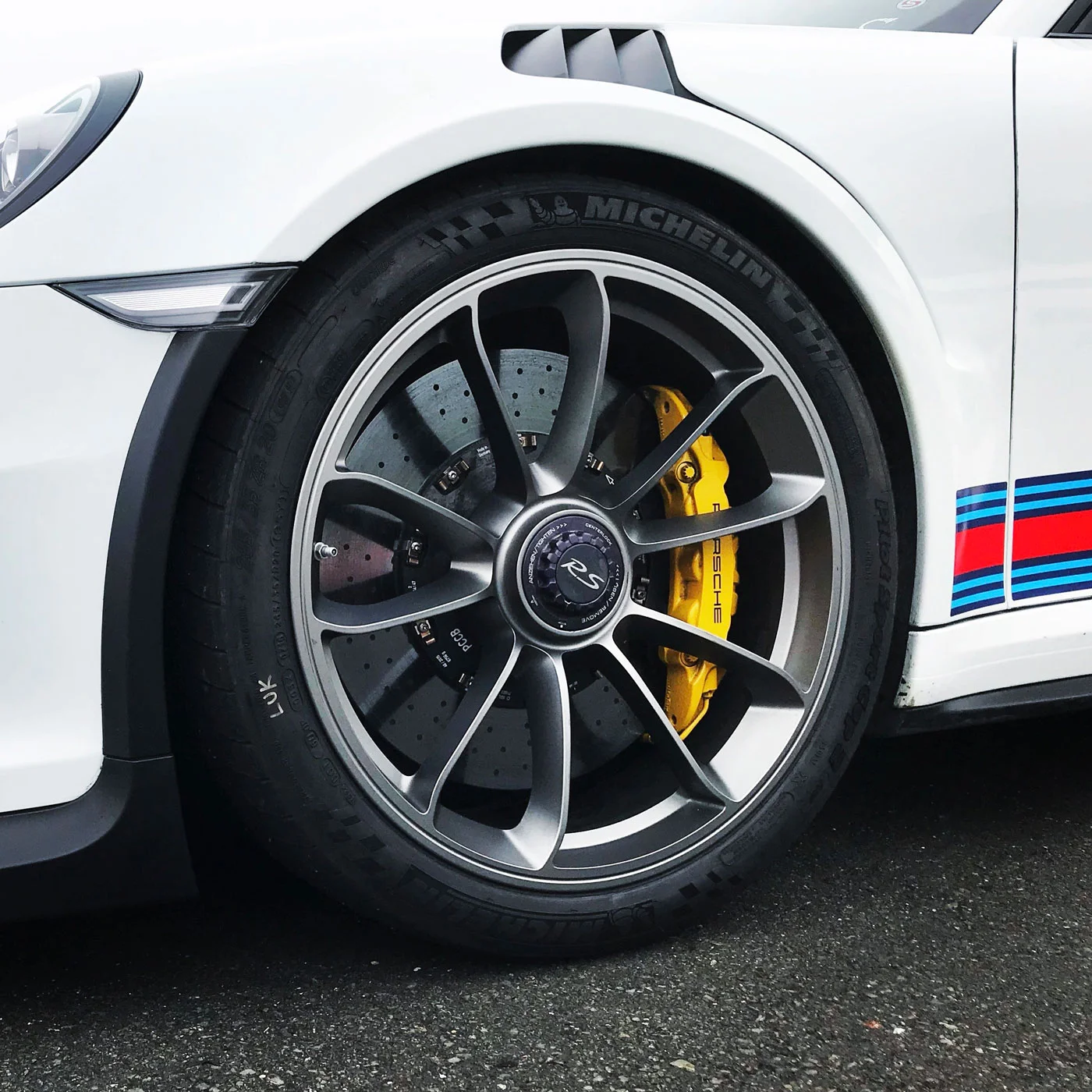
Michelin’s multi-compound construction puts a track-focused elastomer on the outer shoulder, where lateral load concentrates during cornering, and a stiffer street-oriented compound on the inner tread. The effect on a heavy, high-horsepower platform like ones that the Cup 2 comes stock on is that the tire stays linear and readable deep into a corner and stays put for a trip to the corner store. Just think of how a typical 911 GT3 owner might use their car for a rip at the track on Sunday and off to the corner office on Monday.
The Cup 2 (240) needs meaningful heat before it’s doing its best work. Just like the heat resistant V730, the Cup 2 (240) should be driven with caution when cold and take a few laps to reach their full potential. In cold conditions or short autocross runs, the Cup 2 is definitely not the tire of choice. In a track day environment on a car that’s generating heat through every session, it becomes irrelevant, and the tire’s combination of street manners and track capability makes it the most complete daily-driver-to-track-day option in the class.
The Stayers
The sprinters are faster and the sustainers are more practical, but the stayers exist for a different objective entirely: endurance.
Continental ExtremeContact Force
The story behind the Continental ExtremeContact Force isn’t unusual when you think about the aforementioned Hoosier acquisition that brought about the Hoosier Track Attack Pro. The ECF is a Hoosier R7 “purple crack”-derived compound with a Continental designed street-tire carcass. The ECF went Captain Planet in combining the expertise of both brands, producing a tire built specifically for amateur endurance racing that was at one point the spec tire for World Racing League (WRL).
A defining engineering decision of the ECF is that it was designed to be able to be flipped on the rim. In endurance racing, asymmetric tire construction means the inside and outside shoulders wear at different rates. The inside typically wears faster because of race alignment specifications and carrying more load during cornering. Most tires, especially the asymmetric Super 200s, will come apart or lose their structural integrity if you dismount and remount them reversed. Though a directional tire, the ECF was built to be able to run reverse in the dry. This means a tire with worn shoulders can double its effective life.
On a short course against the sprinter Super 200s, the ECF runs consistently slower. An endurance racer choosing between a tire that’s fast for four laps and a tire that’s consistent for six hours already knows this is not necessarily a disadvantage. The ECF’s steering feel and turn-in response are meaningfully better than the Hankook R-S4 it competes most directly against, giving drivers better feedback and more confidence in a situation where they’re managing the car across hundreds of laps rather than optimizing a single qualifying run.
BFGoodrich g-Force Rival+
As a significant divergence from the BFG Rival series’ original sprinter ambitions, the BFGoodrich g-Force Rival+ was designed as an Endurance 200 to compete with the likes of the ECF and R-S4. While the Rival+ shares its “Performance Racing Core” carcass with the Rival S, the tire compound is a ground-up design.
Initial testing has shown the Rival+ turning faster wet lap times than the Hankook R-S4, which has been the default endurance tire for budget teams for years. For a Lemons or WRL team that spends entire weekends at tracks where weather is a variable, a tire that doesn’t fall apart in the rain is not a minor thing. The obvious caveat is pace. The Rival+ is not built to be fast for a lap despite its heritage.
These are relatively new, but Andy Hollis has already put the Rival+ through its paces against the ECF and 1.5 S. Look for more amateur driver reviews as miles are racked up over this track season.
Hankook Ventus R-S4
The R-S4 has been the budget endurance tire for nearly a decade. I personally ran the R-S3s that came before them and have put R-S4s on 3 different street-driven track cars. Things that make the Hankook Ventus R-S4 an effective tire haven’t changed in the nearly ten years since its introduction, and there have not been any rumors about an R-S5.
Hankook built the R-S4 around thermal mass. The 9/32” starting tread depth acts as a heat sink, absorbing and dissipating the thermal energy. The construction is designed to be insensitive to rising pressures, which means the tire doesn’t get greasy or unpredictable as heat builds through a multi-hour session.
The speed deficit, however, is real and consistent. The R-S4’s very progressive transition from grip to slip makes it forgiving to novice and intermediate drivers who are still developing the car control skills and its relatively lower price means more seat time per dollar than any other option in the class. And consistent laps with lots of seat time are especially important for drivers who are learning. The R-S4 still reigns as a value endurance choice or for street-driven cars that may see the track a couple of times a year.
Which Tire for Which Driver
If you stayed with me until the end, you must truly be committed to the cause of a new set of tires. That was a ton of words. The buying decision simplifies once you have settled on which segment actually fits your use case. As tempting as it is to get the stickiest possible tire, a sprinter Super 200 might not actually be the best choice for your use case. The RE-71RZ is the current choice for the best balance of fast warm-up and thermal stability across most platforms with a price tag to match its superiority. Heavier cars should look hard at the Nankang CR-S before defaulting to the Yokohama, especially at the Nankang’s lower price point.
For HPDE and multi-day track events, the Kumho V730 is a sensible all-day choice at its price point. Heavy high-horsepower platforms may be better served by the Michelin Cup 2 (240), which gives up some peak grip in exchange for being a great street tire with occasional track use. And if you’re looking for a 200TW street tire that will last, you might be looking in the same categories as endurance racers.
Frequently Asked Questions
What is a 200 treadwear tire?
Treadwear ratings are assigned by manufacturers based on standardized wear testing — higher numbers mean longer-lasting tread. A 200 rating sits well below typical street tires (400–600) and has become the minimum threshold for many amateur motorsport sanctioning bodies. In practice, it functions as a performance class designation as much as a wear rating.
Are 200 treadwear tires street legal?
Yes. All of the tires in this guide carry a DOT designation and are street legal in the United States. The Hoosier Track Attack Pro is the exception to watch as its 5/32” factory tread depth disqualifies it from some competition classes. Wet traction is a primary consideration if you intend to daily your 200TW tire.
Can you daily drive 200 treadwear tires?
If you have the budget and climate, yes. The Michelin Pilot Sport Cup 2 (240), Kumho Ecsta V730, and Endurance 200s like the Continental ExtremeContact Force, BFGoodrich g-Force Rival+, and Hankook Ventus R-S4 were all designed with street use in mind and handle commuting without issue. The RE-71RZ and A052 are technically street legal but will wear quickly in daily use and perform poorly in cold temperatures. The Hoosier Track Attack Pro is not a practical daily driver.
How long do 200 treadwear tires last?
It depends entirely on the tire and how it’s used. Endurance tires like the Hankook R-S4 and Continental ECF can run a full season or more of track events on one set. Sprint-focused tires like the RE-71RZ and A052 are typically measured in heat cycles rather than miles and most drivers get a competitive season before performance drops noticeably. The Hoosier Track Attack Pro can feel spent after three or four hard sessions even with tread remaining.
What is the best 200 treadwear tire for autocross?
While a subjective “best”, the Bridgestone RE-71RZ is the current benchmark for autocross. It comes up to temperature quickly and its predecessors have accumulated more national championship wins in this class than any other tire.
What is the best 200 treadwear tire for HPDE and track days?
As with anything, it depends. For a full day of track driving, the Kumho Ecsta V730 holds up across multiple sessions better than the sprint-focused tires. Heavy or high-horsepower cars may be better served by the Michelin Pilot Sport Cup 2 (240), which trades some peak grip for consistency and usable street manners between events.
Are 200 treadwear tires good in rain?
Many are not. The Nankang CR-S, Vitour P1, and Hoosier Track Attack Pro are dry-weather compounds that should be treated as such. The Yokohama A052 is among the better options in the wet for this class. The Continental ECF and BFGoodrich Rival+ have the most capable wet performance of the endurance-oriented tires.
What’s the difference between 200TW and 100TW tires?
A 100TW tire is closer to a DOT-legal race tire. It is faster in ideal conditions, but shorter-lived. The 200TW class was designed as a cost-control measure for amateur competition. In practice, the best 200TW tires have closed the gap significantly, for instance, the Hoosier Track Attack Pro has posted faster times than some 100TW competitors in back-to-back testing.