The Nissan 350Z represented a defining moment in affordable sports car engineering. Built on Nissan’s Front Midship (FM) platform, the Z33 pushed the 3.5L V6 VQ35DE engine behind the front axle centerline, achieving a near-neutral 53/47 weight distribution and significantly reducing polar moment of inertia. This layout, combined with a sophisticated multi-link double-wishbone front suspension and multi-link rear, creates a chassis that is exceptionally receptive to modification and thrives on proper wheel and tire selection.
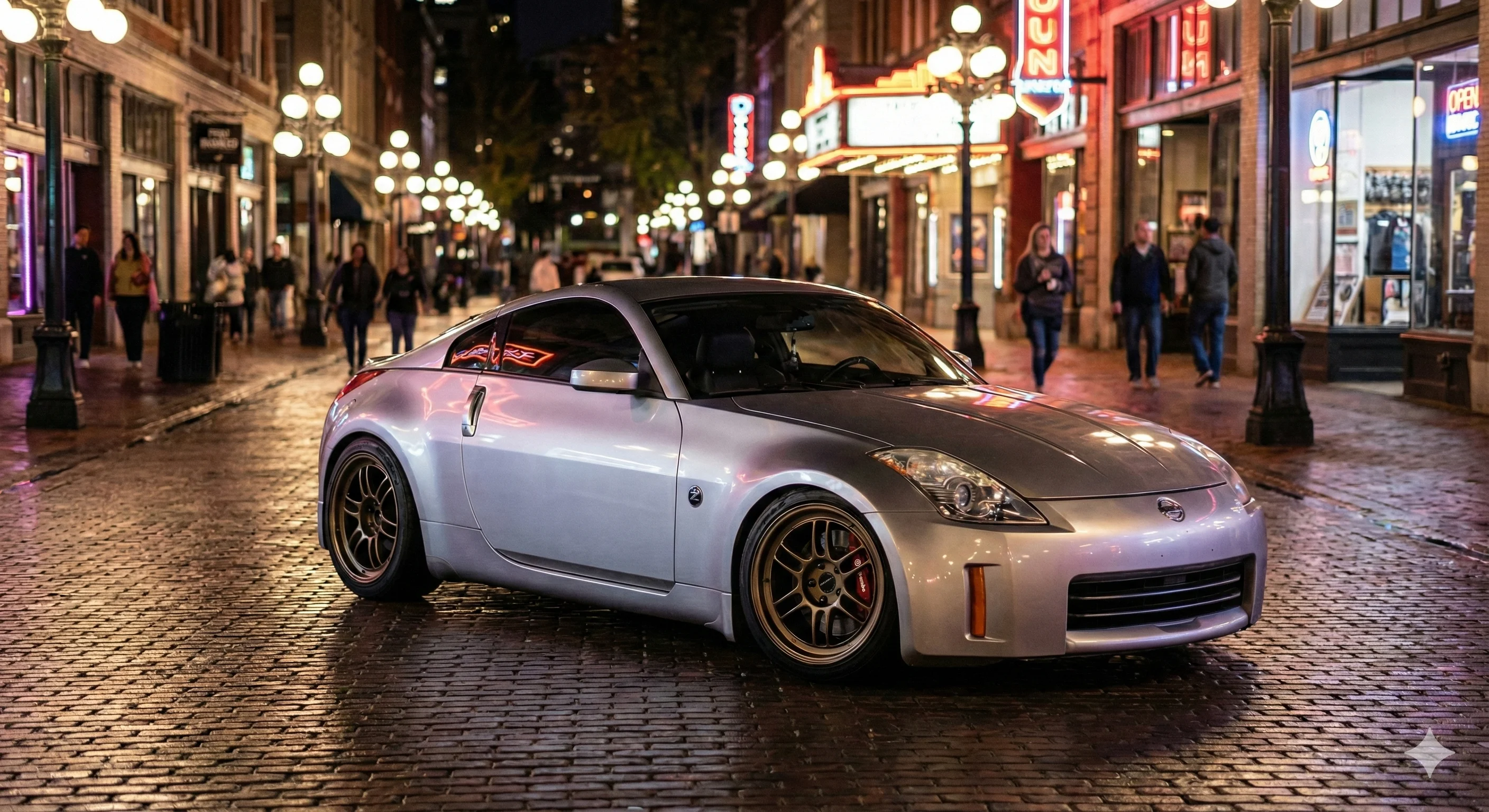
For drift competitors and track enthusiasts, the Z33 offers generous wheel well clearance, substantial suspension travel, and predictable handling dynamics that reward aggressive wheel fitments. This guide provides comprehensive technical information for wheel fitment on the Z33 350Z, with a focus on maximizing mechanical grip for track and competition use.
Platform Note: The Z33 350Z shares the FM platform with the Infiniti G35 Coupe and Sedan (V35 chassis). While fundamental suspension architecture is identical, body width and fender design differ significantly. Infiniti G35 Coupe and Sedan wheel guides are coming soon.
For tire fitment including diameter tolerance and performance categories, see the Z33 350Z Tire Guide. For quick-reference wheel and tire combinations, consult the Z33 350Z Wheel and Tire Cheatsheet.
OEM / Stock Wheel Specifications
All Z33 models share identical hardware specifications regardless of trim level or brake package.
| Bolt Pattern / PCD | 5x114.3 |
| Centerbore | 66.1mm |
| Thread Pitch | M12x1.25 |
| Lug Nut Torque | 80 ft-lbs |
| TPMS Frequency | 315MHz |
Factory Wheel Configuration
| Model / Year | Dimensions | Weight | Tire Size |
|---|---|---|---|
| Base / Enthusiast (2003-2005) | 17x7.5” +30 F 17x8” +33 R | ~23 lbs F ~24 lbs R | 225/50R17 F 235/50R17 R |
| Touring (2003-2005) | 18x8” +30 F / R | ~27 lbs | 225/45R18 F 245/45R18 R |
| Track (2003-2005) | 18x8” +30 F 18x8.5” +33 R | ~18 lbs F ~19 lbs R | 225/45R18 F 245/45R18 R |
| Base / Enthusiast / Touring (2006-2009) | 18x8” +30 F 18x8.5” +33 R | ~24 lbs F ~26 lbs R | 225/45R18 F 245/45R18 R |
| Track / Grand Touring (2006-2009) | 18x9” +30 F 19x10” +30 R | ~21 lbs F ~29 lbs R | 245/40R18 F 265/35R19 R |
| NISMO (2007-2008) | 18x9” +30 F 19x10” +30 R | ~21 lbs F ~29 lbs R | 245/40R18 F 265/35R19 R |
The factory staggered setups, found on all but the early Touring trim, reflect Nissan’s engineering priorities: maintaining a rear diameter bias for VDC compliance (approximately 3% larger rear) while providing adequate rear grip for the rear-wheel-drive platform. The later 2006-2008 Track, GT, and NISMO trims feature the most aggressive factory fitment with 18x9” front and 19x10” rear forged wheels made by Rays Engineering.
Aftermarket Considerations
Suspension Geometry and Scrub Radius
The Z33 employs a sophisticated multi-link double-wishbone front suspension. The upper control arm’s geometry creates aggressive camber gain during compression, allowing wheels that appear flush at static height to tuck deeply into the fender well under cornering loads.
Moving from the factory +30mm offset to aftermarket offsets in the +15 to +22 range increases positive scrub radius, amplifying steering feedback and road feel. Track drivers often prefer this characteristic as it provides more communication about tire loading and grip levels. However, increased scrub radius also makes the car more susceptible to tramlining and increases steering effort at low speeds. For dedicated track cars where maximum front grip outweighs street manners, the trade-off is worthwhile.
Front Upper Control Arm Clearance
The front upper control arm represents the primary inboard clearance constraint when running wide front wheels. The factory upper arm’s ball joint housing sits close to the inner tire sidewall, particularly on lowered cars where the arm angle becomes more acute. When fitting 9.5” or wider front wheels, careful attention must be paid to offset selection and tire profile.
High offsets (+35mm or higher) on 9.5” wheels push the inner rim lip dangerously close to the upper arm casting. Under full compression with aggressive negative camber, contact becomes likely. As a known OE limitation, aftermarket adjustable upper control arms feature slim-profile designs specifically engineered to provide additional clearance, but even these have limits. Aftermarket control arms will provide approximately 10mm of additional clearance. For 10.5” front widths (common in square track setups), offsets in the +15 to +25 range are typically required to maintain adequate inboard clearance.
Fender Impact Considerations
The Z33’s rear fender features an L-shaped return tab where the quarter panel sheet metal folds inward. Unlike modern vehicles with pre-rolled or plastic fender lips, this edge can contact tire sidewalls during suspension compression on lowered cars or aggressive fitments.
Fender rolling requirements depend on the combination of ride height, wheel offset, and tire size. Stock suspension height with conservative setups (18x9.5” +22 with 255mm tires) typically requires no fender work. However, lowered suspension combined with aggressive offsets (+15 or lower on 9.5”) and wide tires (275mm+) will require fender rolling to prevent contact. The process involves heating the paint and mechanically folding the tab flat against the inner fender skin using a dedicated fender roller, yielding approximately 10-15mm of additional clearance.
Front fender liner contact can occur on lowered Z33s with larger wheel diameters (19” with tall sidewalls). Some owners address this by trimming or heat-molding the plastic liner to create additional clearance, though ensuring proper liner mounting and hardware is often sufficient.
Brake Clearance Considerations
The Z33 was offered with two distinct brake packages, each with different wheel clearance requirements.
Standard Floating Calipers (Base/Enthusiast/Touring/Roadster): Single or dual-piston sliding calipers with a low-profile design. These compact calipers clear virtually any aftermarket wheel meeting basic dimensional requirements.
Brembo 4-Piston Fixed Calipers (Track/Grand Touring): 324mm front rotors with fixed 4-piston calipers. These larger calipers require careful wheel spoke design verification. The critical measurement is not offset but rather spoke profile. A wheel must feature curved spokes that arch outward from the hub to clear the bulky caliper face before diving back toward the rim lip. Wheels with flat “deep dish” spoke designs often contact the caliper face regardless of offset.
Minimum 18” diameter is recommended for Brembo applications, though some 17” wheels with high-disk spoke profiles can fit. Always verify brake clearance with wheel manufacturers or use physical templates before purchasing.
Akebono Big Brake Kits (Aftermarket Retrofit): Many Z33 owners retrofit Akebono 6-piston calipers from the 370Z using adapter brackets. These calipers are physically larger than the Z33 Brembos in every dimension. A wheel that clears Brembos by 2-3mm will not clear Akebonos. Verify clearance when retrofitting these brakes.
Square vs. Staggered Setups
The choice between square (same width all around) and staggered (wider rear) configurations fundamentally alters the Z33’s handling character.
Staggered Configurations maintain the factory handling bias with slight understeer at the limit. The wider rear tire provides a higher adhesion limit than the front, ensuring the car pushes rather than spins when grip is exceeded. This configuration is ideal for high-horsepower builds where rear traction is the limiting factor. The trade-off is inability to rotate tires and accelerated rear tire wear.
Square Configurations increase front grip relative to the rear, neutralizing factory understeer and promoting rotation. This setup is preferred for track work where balanced handling and the ability to rotate tires extend consumable life. Square setups often employ 10.5” widths with aggressive offsets (+15 to +25) and require aftermarket upper control arms to manage inboard clearance. For VDC-equipped street cars, square tire diameters may trigger traction control intervention. VDC can and should be disabled. See tire guide for details.
Weight and Rotational Inertia
The Z33’s multi-link suspension provides excellent wheel control, but the platform’s dynamics improve dramatically with reduced unsprung weight. Factory Track/GT wheels weigh 21-23 lbs each. High-quality forged alternatives like the RAYS TE37 (18x9.5” at 17.8 lbs) or Enkei RPF1 (18x9.5” at 18.5 lbs) can reduce unsprung weight by 3-5 lbs per corner (12-20 lbs total) while simultaneously increasing wheel width.
This reduction improves suspension response over mid-corner bumps, reduces brake temperatures through decreased rotational inertia, and enhances acceleration through lower rotating mass. For dedicated track cars, wheel weight should be prioritized alongside width and offset selection.
Hub Centric Rings
Most aftermarket 5x114.3 wheels are manufactured with 73.1mm center bores for universal fitment. The Z33 requires 66.1mm hub centering. Hub centric rings are mandatory. Aluminum rings are strongly recommended over plastic for track use, as the Z33’s Brembo brakes generate substantial heat that can deform plastic rings, leading to vibration and difficult removal.
Load Rating Requirements
The Z33 has a curb weight starting at 3,188 lbs, increasing with higher trim levels. Gross axle weight ratings are approximately 1,906 lbs front and 1,929 lbs rear. This translates to a minimum load rating requirement of approximately 1,000 lbs per wheel. Most reputable wheel manufacturers offer load ratings above this threshold. If you are buying wheels from a manufacturer that cannot provide load rating information, it’s best to look elsewhere.
Wheel Recommendations
Below are recommendations based on suspension geometry, brake clearance profiles, and real-world experience from the Z33 drift and track community. These are general recommendations focused on wheel dimensions and offset ranges. Wheels with different spoke designs and barrel profiles may fit differently. Always verify fitment for your specific setup and brake package.
OEM+ Recommendations (Staggered)
Conservative staggered sizes that maintain or improve upon factory specifications without requiring body modifications. These sizes work well for daily drivers, winter setups, or owners prioritizing reliability.
| Front | Rear | Offset Range | Notes |
|---|---|---|---|
| 18x8.5” | 18x9.5” | +30 to +35 | Direct OEM+ upgrade, 245/40R18 F / 265/40R18 R, no modifications required |
| 18x9” | 18x9.5” | +25 to +30 | Moderate width increase, 255/40R18 F / 265/40R18 R, excellent clearance |
| 18x9” | 18x10” | +25 to +30 | Wider rear for improved traction, 255/40R18 F / 275/40R18 R, minimal fender work when lowered |
These conservative staggered sizes provide maximum clearance margins, require no body modifications on stock suspension, and maintain near-factory scrub radius characteristics while offering improved tire options and grip.
Aggressive Street Recommendations (Staggered)
The optimal balance of performance and fitment ease. These staggered sizes represent the sweet spot for Z33 owners seeking improved track width and flush aesthetics without extensive modifications.
| Front | Rear | Offset Range | Notes |
|---|---|---|---|
| 18x9.5” | 18x10.5” | +22 | Z33 “Enthusiasts’ Choice” - 255/40R18 F / 275/35R18 R, minimal fender rolling when lowered |
| 18x9.5” | 18x10.5” | +15 | Maximum concavity, 255/35R18 F / 275/35R18 R, fender rolling or additional camber required |
| 19x9.5” | 19x10.5” | +22 | 19” variant, 255/35R19 F / 275/35R19 R, minimal fender rolling when lowered |
| 19x9.5” | 19x10.5” | +15 | Aggressive 19” setup, 255/35R19 F / 275/35R19 R, fender rolling or additional camber required |
The 18x9.5” +22 front / 18x10.5” +22 rear staggered combination is a popular enthusiast’s choice for the Z33. This setup provides aggressive track width and flush appearance while maintaining adequate clearance for spirited street driving with proper fender preparation. The +22 offset works with minimal fender rolling on lowered cars, while +15 offset creates maximum concavity and track width at the expense of requiring more aggressive fender work.
Track / Competition Recommendations (Square)
Maximum grip configurations for dedicated track use or competition builds. Square setups eliminate the front/rear grip imbalance, promoting neutral handling and tire rotation for extended track life.
| Wheel Dimensions | Offset Range | Notes |
|---|---|---|
| 18x10” (square) | +15 | SCCA Touring Class Spec and NASA Spec Z, 275/35R18, requires minimum -3.0° camber |
| 18x10” (square) | +25 | Conservative square setup, 275/35R18, may require aftermarket upper control arms |
| 18x10.5” (square) | +15 to +25 | 275/35R18 or 285/30R18, may require aftermarket upper control arms and fender work, minimum -3.0° camber |
| 18x11” (square) | +15 to +22 | For dedicated Track builds, 295/35R18, requires extensive modifications |
Square setups using 10” or 10.5” width with offsets in the +15 to +25 range deliver maximum front grip to combat understeer and allow tire rotation to extend track consumable life. These configurations require aftermarket upper control arms with slim-profile designs (FDF Race Shop, GKTech, SPL) to prevent tire-to-arm contact under compression. Negative camber in the -2.5° to -3.5° range is typical, necessitating camber plates or adjustable coilovers. Rear fender rolling is mandatory. For VDC-equipped street cars, square tire diameters may trigger traction control intervention.
Cross-Platform Compatibility
The Z33 shares its Front Midship platform and fundamental hub architecture with the Infiniti G35 Coupe and Sedan (V35 chassis). All three vehicles utilize identical bolt patterns (5x114.3), center bore (66.1mm), and thread pitch (M12x1.25), making wheels mechanically interchangeable. However, physical differences in body width create distinct fitment characteristics.
Z33 vs. G35 Coupe Differences
The G35 Coupe features wider rear fenders, providing approximately 20mm of additional clearance compared to the Z33. Wheel setups that fit flush on the Z33 (18x10.5” +22) will appear slightly conservative on the G35 Coupe. Z33 wheel specs transfer directly to the G35 Coupe with additional clearance margin. G35 Coupe-specific aggressive specs (19x10.5” +12 rear) will not fit the Z33 without extreme fender modifications.
Z33 vs. G35 Sedan Differences
The G35 Sedan features significantly narrower rear fenders than both the Z33 and G35 Coupe. Wheel specs that work on the Z33 will be excessively aggressive on the Sedan. The Sedan requires more conservative offsets (+35 to +40 rear) to avoid poke and fender contact. Z33 owners’ “flush” setups (18x10.5” +22) will extend approximately 30mm beyond the Sedan’s fender, requiring stretched tires and extreme negative camber. Do not purchase Z33 or G35 Coupe wheel specs for a G35 Sedan without understanding the body width difference.
Additional Resources
- Reddit: The OG Wheel Info thread from ntran2
- Tire Compatibility: See the Z33 350Z Tire Guide for tire size recommendations, diameter calculations, and VDC stagger requirements
- Quick Reference: Z33 350Z Wheel and Tire Cheatsheet for validated wheel and tire pairings
- Related Platform Guides: Infiniti G35 Coupe and G35 Sedan wheel guides coming soon
Remember: Actual fitment varies based on wheel design (spoke profile, barrel shape), tire selection, suspension setup, ride height, camber, and fender condition. Always verify fitment for your specific combination and brake package before purchasing. For aggressive fitments, budget for aftermarket upper control arms, fender rolling, and alignment as mandatory supporting modifications. Track use demands quality wheels with appropriate load ratings and professional installation. All information provided is based on extensive research and community trial and error. Please evaluate and verify fitment data at your own discretion. As always, modify at your own risk.