The tires on your Tesla Model 3 will wear out well before anything else on your car does. The Standard Range, Long Range, and Stealth Performance trims all shipped on 18” “Aero” wheels using a 235/45R18 tire. When it’s time to replace them, there are better and often cheaper options than the OEM tire. This guide covers what came from the factory, what actually matters when you’re buying replacements, and which categories to shop. For 19” Sport wheels see the 19” guide. For 20” Performance wheels see the 20” guide.
OEM Wheel and Tire Specs
The Model 3 Aero wheel is an 18x8.5” wheel with a +40 offset and 5x114.3 bolt pattern. There were two Aero variants over the original Model 3 pre-Highland production run, but both used the same wheel dimensions and the same OEM tire size.
The 18” Aero V1 was standard on all Standard Range and Long Range models from the start of production through September 2020. The 18” Aero V2 followed from October 2020 onward with a revised spoke design and updated Aero cap, retaining the same dimensions. Performance trim owners who ordered a car without the 20” Sport wheels and larger brakes, the so-called “Stealth Performance” or P3D- configuration, also received the 18” Aero.
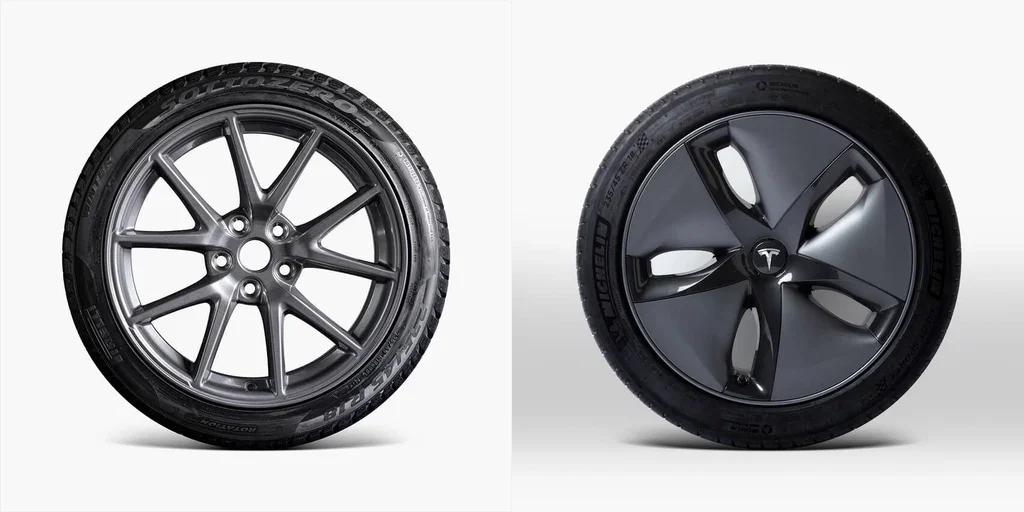
Both Aero variants shipped with a 235/45R18 tire with an acoustic foam inner liner. The primary OEM tire was the Michelin Primacy MXM4 carrying a Tesla T1 designation and a 98W XL service description. Later V2 production during the COVID pandemic shifted to the Hankook Kinergy GT for approximately a year, carrying a Tesla T0 designation and a 94V SL service description. The Michelin Pilot Sport 4 was offered in some non-U.S. markets as was the Hankook Ventus S1 AS and Michelin Primacy A/S on later Gen 1 vehicles. All featured T0 or T1 designations and acoustic foam lining.
| Tire Model | Load/Speed | Notes |
|---|---|---|
| Michelin Primacy MXM4 | 98W XL | T1, Primary OEM |
| Hankook Kinergy GT | 94V SL | T0, Some models, October 2020+ |
| Michelin Pilot Sport 4 | 98Y XL | T0, Non-U.S. market summer tire |
| Hankook Ventus S1 AS | 98W XL | T0, Later models |
| Michelin Primacy A/S | 98W XL | T0, Later models |
Though the Hankook models are still in the factory service manual as of this publishing, the actual tire models are not widely available and newer factory models have carried on with different tires.
The T0 and T1 markings indicate Tesla has tested and approved the tire for noise, ride, and range to their standards. They also indicate the tire manufacturer paid for that certification. You do not need to buy a T0, T1, etc. tire to replace your existing tires. Many non-designated tires outperform the OEM options in traction and longevity categories.
Before You Buy
Tire size. The OEM size is 235/45R18. This is a slightly stretched fit on the 8.5” wide Aero wheel, but it is within spec and what Tesla chose from the factory. Owners looking to maximize range can go down to 225/45R18 which provides a narrower contact patch to reduce rolling resistance but is a more pronounced stretch on the wheel. Owners who prioritize grip over efficiency can move up to 245/45R18, which is a better fit on the 8.5” rim and delivers a slightly larger contact patch. All three sizes are within 3% of the OEM overall diameter and are safe fitments for the car. For other compatible tire sizes see our 235/45R18 Tire Table.
Load index. The OEM tire service descriptions diverged between the Michelin MXM4 (98W XL) and the Hankook Kinergy GT (94V SL). Tesla’s owner’s manual at one point required XL-rated tires but updated that position when the Hankook’s SL became the OEM tire, though the Hankook is no longer available in the OEM size. The conservative approach is to match or exceed a 94 load index at minimum. An XL-rated tire at 98 load index is a fine choice and costs nothing extra in most cases. All-season tires in this size routinely come in XL. If you are buying summer performance tires, check the specific product information. Some are SL-rated, and those are acceptable under Tesla’s current guidance.
Acoustic foam liner. The OEM spec Tesla tires all include foam inner liners to reduce road noise. There is no engine noise in a Model 3 to mask tire drone, so the foam can make a difference on coarse pavement. That being said, plenty of owners run non-foam tires without complaint. If road noise is a priority, look for the acoustic variant of a tire: Michelin labels them “Acoustic,” Continental uses “ContiSilent,” Pirelli uses “PNCS.” Not every recommended tire has an acoustic version available in 235/45R18, and that is fine. Be aware that foam inner liners complicate plug-and-patch repair and some shops will decline this work.
TPMS. The Model 3 uses direct TPMS with sensors integrated into the valve stem assembly. During a tire swap, the valve stem and sensor stay in the wheel. The installer demounts the old tire, mounts the new one, and the sensor is never disturbed. You should not be charged for a new sensor on a standard replacement. A valve stem seal inspection or replacement is normal and inexpensive. After the swap, recalibrate via Controls > Service > TPMS Calibration on the touchscreen.
Replacing in pairs. Unlike most AWD vehicles, you do not need to replace all four tires at the same time on a Dual Motor Model 3. Replace in pairs and put the newer tires on the rear axle. The exception is a flat on a nearly-new tire. If the remaining tread depth on the undamaged tire is within 1.5mm of new, a single replacement on that axle is acceptable. Rear tires on the Model 3 wear faster than fronts, so rotate every 5,000–6,000 miles to keep tread depth even.
Grand Touring All-Season
Standard Range and Long Range owners who want a comfortable, long-wearing tire that handles light snow will find everything they need in the Grand Touring All-Season category. This is also the correct category if you are replacing a worn-out Primacy MXM4 or Kinergy GT with something comparable or better.
| Size | Tire | Price/Tire |
|---|---|---|
| 235/45R18 | ||
| 235/45R18 | Continental SecureContact AW | $211.99 |
| 235/45R18 | Goodyear Assurance WeatherReady2 | $240.99 |
| 235/45R18 | Michelin CrossClimate2 | $242.99 |
| 235/45R18 | Michelin Primacy MXM4 (OEM) | $268.99 |
| 235/45R18 | Vredestein Quatrac Pro+ | $218.77 |
| Alternative Sizes · 245/45R18 | ||
| 245/45R18 | Continental SecureContact AW | $266.99 |
| 245/45R18 | Goodyear Assurance WeatherReady2 | $297.99 |
| 245/45R18 | Michelin CrossClimate2 | $305.99 |
| 245/45R18 | Vredestein Quatrac Pro+ | $227.77 |
Price availability updated May 2026. Actual prices may vary.
In recent years the major tire brands have sought 3-Peak Mountain Snowflake rating on their signature tires for all-weather capability, and all of our recommendations are 3PMSF-rated. Continental has relatively recently released the SecureContact AW which features a lower price tag and a cutting edge compound that prioritizes traction and efficiency. Michelin’s CrossClimate 2 has typically been the pick for those seeing more inclement weather, but the value standouts come from Vredestein. Their tires typically test well against the higher priced tires in their categories with noticeably lower pricing.
Ultra High Performance All-Season
If you want more handling capability without giving up year-round usability, Ultra High Performance All-Season tires sharpen the car without locking you out of rain or light snow. These tires respond better to the Model 3’s acceleration and cornering than the grand touring category and are a good fit for Stealth Performance owners who still want four-season capability.
| Size | Tire | Price/Tire |
|---|---|---|
| 235/45R18 | ||
| 235/45R18 | Bridgestone Potenza RE980AS+ | $199.76 |
| 235/45R18 | Continental ExtremeContact DWS 06 Plus | $200.99 |
| 235/45R18 | Michelin Pilot Sport All Season 4 | $224.99 |
| 235/45R18 | Pirelli P Zero AS Plus 3 | $226.04 |
| Alternative Sizes · 245/45R18 | ||
| 245/45R18 | Bridgestone Potenza RE980AS+ | $185.58 |
| 245/45R18 | Continental ExtremeContact DWS 06 Plus | $195.99 |
| 245/45R18 | Michelin Pilot Sport All Season 4 | $219.99 |
| 245/45R18 | Pirelli P Zero AS Plus 3 | $229.92 |
Price availability updated May 2026. Actual prices may vary.
The Continental ExtremeContact DWS line and the Michelin Pilot Sport AS lines are perennial favorites among consumers.
Summer Performance
For owners in mild climates who want the full performance the platform is capable of, summer tires are the ticket. Expect meaningfully better dry and wet grip, faster steering response, and higher road noise than their all-season counterparts. These are warm-weather-only tires. The compound loses grip below 40°F and becomes a liability below freezing on snow and ice. The Stealth Performance trim in particular benefits from summer tires as the all-season OEM tire is a meaningful limiter on a car with that much torque.
| Size | Tire | Price/Tire |
|---|---|---|
| 235/45R18 | ||
| 235/45R18 | Bridgestone Potenza RE-71RZExtreme Performance Summer | $311.94 |
| 235/45R18 | Yokohama Advan A052Extreme Performance Summer | $341.99 |
| 235/45R18 | Bridgestone Potenza SportMax Performance Summer | $257.81 |
| 235/45R18 | Continental ExtremeContact SportMax Performance Summer | $240.99 |
| 235/45R18 | Michelin Pilot Sport 4Max Performance Summer | $262.99 |
| 235/45R18 | Michelin Pilot Sport 4SMax Performance Summer | $274.99 |
| 235/45R18 | Vredestein Ultrac ProMax Performance Summer | $174.25 |
| Alternative Sizes · 245/45R18 | ||
| 245/45R18 | Bridgestone Potenza RE-71RZExtreme Performance Summer | $352.70 |
| 245/45R18 | Continental ExtremeContact SportMax Performance Summer | $229.99 |
| 245/45R18 | Michelin Pilot Sport 4SMax Performance Summer | $253.99 |
| 245/45R18 | Vredestein Ultrac ProMax Performance Summer | $185.90 |
Price availability updated May 2026. Actual prices may vary.
Visit TireRack to find full availability in 235/45R18 or 245/45R18 sizing.
Winter
If you live somewhere with real winter, a dedicated seasonal swap outperforms any all-season. The stopping distance gap between a winter tire and an all-season on ice is significant. Running a second set of wheels with winters mounted is typically more economical than paying a shop to swap tires on the stock wheels twice a year.
Performance Winter and Snow
Performance winter tires deliver full 3-Peak Mountain Snowflake-rated winter capability while retaining meaningful dry and wet handling for drivers who cover highway miles in winter conditions. These tires are suitable for all Model 3 trims and are a natural choice for owners in climates that see snow regularly but not severely. Tesla’s OEM Winter Wheel package features Pirelli's Winter Sottozero 3. This is a relatively unique winter tire as it retains a foam lining and features a T0 Tesla designation.
| Size | Tire | Price/Tire |
|---|---|---|
| 235/45R18 | ||
| 235/45R18 | Pirelli Winter Sottozero 3 (OEM) | $295.32 |
| 235/45R18 | Vredestein Wintrac Pro+ | $190.25 |
| Alternative Sizes · 245/45R18 | ||
| 245/45R18 | Vredestein Wintrac Pro+ | $210.04 |
Price availability updated May 2026. Actual prices may vary.
Studless Ice and Snow
Studless ice and snow tires prioritize maximum traction in severe winter conditions — ice, packed snow, and deep cold — over dry-road performance. Tread life is lower and dry handling is softer than a performance winter, but on a bad winter day these tires make a meaningful safety difference. Best suited for owners in regions with long, harsh winters.
| Size | Tire | Price/Tire |
|---|---|---|
| 235/45R18 | ||
| 235/45R18 | Bridgestone Blizzak WS90 | $232.33 |
| 235/45R18 | Michelin X-Ice Snow | $211.12 |
| Alternative Sizes · 225/50R18, 245/45R18 | ||
| 225/50R18 | Bridgestone Blizzak WS90 | $218.50 |
| 225/50R18 | Continental VikingContact 8 | $226.99 |
| 225/50R18 | Michelin X-Ice Snow | $216.10 |
| 245/45R18 | Bridgestone Blizzak WS90 | $227.36 |
Price availability updated May 2026. Actual prices may vary.
Mounting and Installation
A few reminders specific to the Model 3:
- TPMS sensors stay in the wheel. Do not pay for new sensors on a standard tire swap. A valve stem seal check is normal and worth doing; a new sensor unit is not necessary unless your existing sensor has failed.
- Recalibrate TPMS after the swap via the touchscreen: Controls > Service > TPMS Calibration.
- Lug nut torque spec: 129 lb-ft. Confirm your installer knows the torque spec and has a properly calibrated torque wrench.
- New tires go on the rear. When replacing in pairs, always put the newer tires on the rear axle regardless of which axle wore faster.