A tire’s load index is a number that maps to a maximum weight the tire can carry at its rated speed and pressure. That information lives in the tire’s service description, the string of numbers and letters at the end of the tire size, like 98Y SL — and most buyers ignore it completely. For most replacement decisions that is fine. For some it matters quite a bit. This article explains what the numbers mean, how to calculate what your vehicle actually needs, and where the edge cases are.
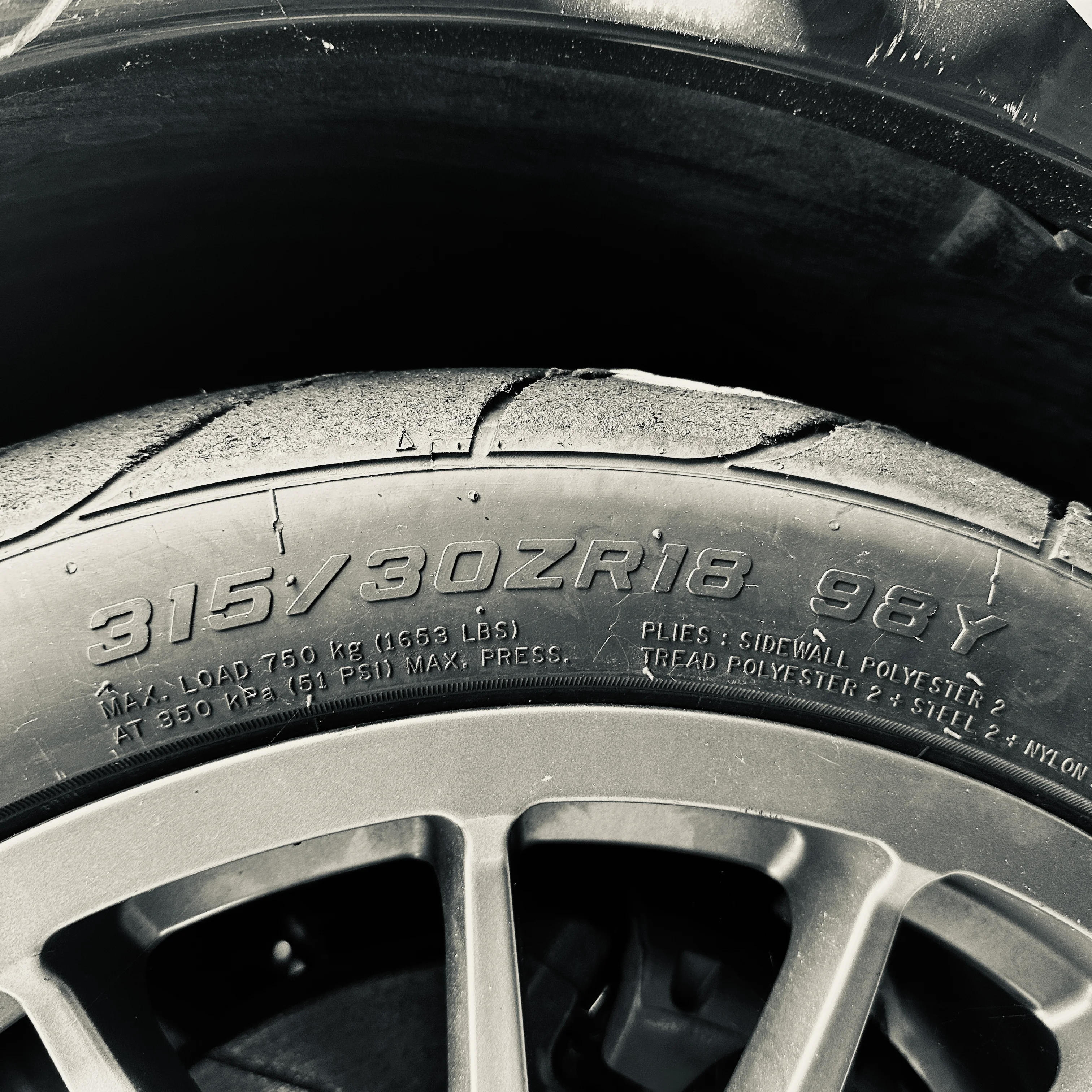
Decoding the Service Description
When you read a tire size like 315/30ZR18 98Y SL, the 98Y SL at the end is the service description. It carries three pieces of information:
- 98 — the load index
- Y — the speed rating
- SL — the load range designation (Standard Load)
Each part is independent. A tire can have a high load index with a moderate speed rating, or a low load index with a maximum speed rating. The load range designation (SL or XL) is not a quality tier, it specifies the construction and the reference inflation pressure at which the load index is certified.
The Load Index Number
The load index is a shorthand code. It maps to a standards table rather than directly stating the weight. When viewed in a chart you can see the load indices are essentially a metric measurement.
| Load Index | Lbs | Kgs | Load Index | Lbs | Kgs | |
|---|---|---|---|---|---|---|
| 80 | 992 | 450 | 101 | 1819 | 825 | |
| 81 | 1019 | 462 | 102 | 1874 | 850 | |
| 82 | 1047 | 475 | 103 | 1929 | 875 | |
| 83 | 1074 | 487 | 104 | 1984 | 900 | |
| 84 | 1102 | 500 | 105 | 2039 | 925 | |
| 85 | 1135 | 515 | 106 | 2094 | 950 | |
| 86 | 1168 | 530 | 107 | 2149 | 975 | |
| 87 | 1201 | 545 | 108 | 2205 | 1000 | |
| 88 | 1235 | 560 | 109 | 2271 | 1030 | |
| 89 | 1279 | 580 | 110 | 2337 | 1060 | |
| 90 | 1323 | 600 | 111 | 2403 | 1090 | |
| 91 | 1356 | 615 | 112 | 2469 | 1120 | |
| 92 | 1389 | 630 | 113 | 2535 | 1150 | |
| 93 | 1433 | 650 | 114 | 2601 | 1180 | |
| 94 | 1477 | 670 | 115 | 2679 | 1215 | |
| 95 | 1521 | 690 | 116 | 2756 | 1250 | |
| 96 | 1565 | 710 | 117 | 2833 | 1285 | |
| 97 | 1609 | 730 | 118 | 2910 | 1320 | |
| 98 | 1653 | 750 | 119 | 2998 | 1360 | |
| 99 | 1709 | 775 | 120 | 3086 | 1400 | |
| 100 | 1764 | 800 | 121 | 3197 | 1450 |
Passenger tire load indices typically run from the mid-80s to around 110. The number increments are not linear. Each step up the index represents a larger jump in load capacity at the higher end of the range. The maximum load figure is per tire at the tire’s maximum rated inflation pressure. The load capacity of a set of four tires is four times the single-tire capacity.
Standard Load vs Extra Load
The SL and XL designations define the reference inflation pressure at which the load index is certified. A Standard Load (SL) tire’s load index is rated at 35 psi (36 psi for Euro-metric). That means the maximum load printed on the tire is only valid when the tire is inflated to that pressure. The tire can physically hold more than 35 psi without immediately failing, but no additional load capacity is gained beyond the certified pressure because the rating doesn’t extend past it.
Extra Load (XL) tires, also called Reinforced in European sizing, certify their load index at 41 psi (42 psi for Euro-metric). Because the rating is measured at a higher reference pressure, XL tires carry more load in the same size than an SL tire can. An XL tire must actually be run at its higher inflation pressure to deliver that rated capacity. An XL tire inflated to 35 psi carries no more load than an SL at 35 psi.
This distinction matters because inflation pressure and load capacity are linked. If the vehicle spec calls for an XL tire and you install an SL, the SL’s load capacity at the door jamb pressure is lower than what the vehicle spec requires. An SL tire is not inferior to an XL tire. It is simply rated for a different load capacity. On a vehicle that does not require the higher rating, an SL is the correct tire. XL designation does not mean the tire is heavier, stiffer, or higher performance than an SL in the same size. Many grand touring all-season tires come only in XL because the vehicle manufacturer chose XL for load margin on heavier models. Some summer performance tires in the same size come in SL because they were designed for lighter sports cars. The designation reflects load capacity engineering, not performance category.
Why EVs Are Almost Always XL
Electric vehicles are meaningfully heavier than their internal combustion equivalents. The battery packs add 400-1,000+ lbs to the curb weight depending on the platform. Tesla, BMW, Mercedes-Benz, and others consistently specify XL-rated tires across their EV lineups because the higher load capacity is necessary at a safe inflation pressure. When replacing EV tires, check whether the OEM spec is XL and match it. See Tire Compound & Technology for more on EV-specific tire considerations. For how XL and HL specs apply in practice, see our tire guides for the Rivian R1S, Tesla Model Y, and Hyundai IONIQ 5.
High Load (HL)
High Load (HL) is a newer ETRTO standard developed specifically for heavy battery electric vehicles that have outgrown what XL construction can reliably support. Where XL certifies its load index at 41 psi, HL certifies at 50 psi. The higher reference pressure allows a tire in the same physical size to carry substantially more load without requiring a physically larger or heavier tire.
The practical effect is an HL-rated tire in a given size carries meaningfully more load capacity than an XL-rated tire in the same size at the same inflation pressure. That gap matters for vehicles like the Rivian R1S, which can exceed 7,000 lbs GVWR in a footprint that would otherwise be limited to XL’s ceiling.
HL tires appear in size strings with the HL prefix like HL275/50R22 and the designation signals a different construction standard. If your vehicle’s OEM spec lists an HL tire, aim to fit an HL replacement. Fitting an XL in the same size delivers less load capacity at the same inflation spec than the vehicle engineer specified.
HL availability is limited compared to SL and XL but expanding as manufacturers build EV-specific lineups. Pirelli’s Scorpion MS and P Zero All Season Plus 3 are currently among the most common HL offerings in large SUV sizes.
Calculating What Your Vehicle Needs
To determine the minimum load index you need, start with your vehicle’s gross axle weight rating (GAWR). This is the maximum rated load for each axle, including the vehicle weight and any cargo. It is on the certification label, usually the same door jamb sticker that shows the tire size and inflation spec. The label typically shows both kg and lbs — use kg, since the load index table is a metric standard.
The calculation for the required load index per tire:
Required load per tire (kg) = GAWR (kg) ÷ 2Find that weight in the load index table and use the corresponding index as your minimum. The OEM tire’s load index already reflects this calculation plus a safety margin, so if you are replacing in the same size, matching or exceeding the OEM load index is the correct approach.
Real-World Example
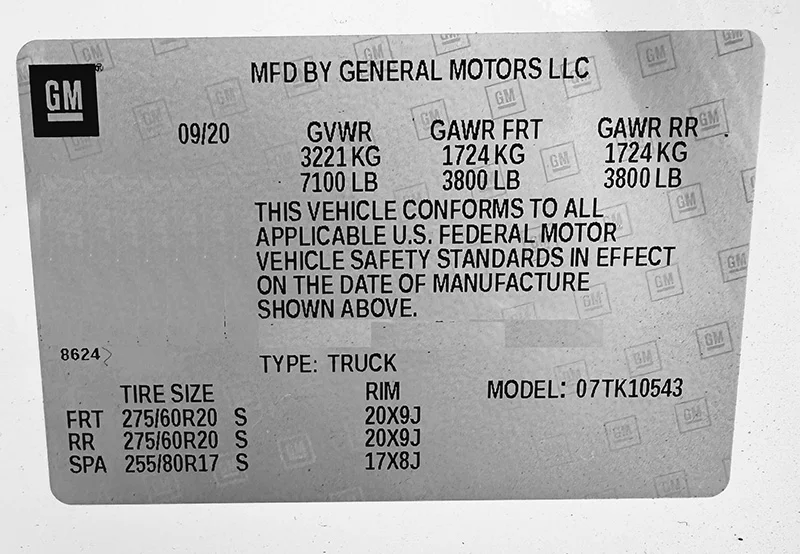
Our example is from a 2020 GMC Sierra with a front and rear GAWR of 1,724 kg (3,800 lbs) — equal front and rear, which makes the math straightforward. Your vehicle will likely have differing GAWR front and rear.
- Front: 1,724 ÷ 2 = 862 kg per tire → load index 102 minimum (850 kg)
- Rear: 1,724 ÷ 2 = 862 kg per tire → load index 102 minimum (850 kg)
The OEM tire’s load index will already exceed this minimum. OEM specs are not chosen at the floor. They include a safety margin above the calculated requirement.
Load Range Letters on LT Tires
Light truck tires use a different rating system based on load range letters: C, D, E, F. Each corresponds to a ply rating and a maximum inflation pressure:
| Load Range | Max Inflation (psi) | Equivalent Ply Rating |
|---|---|---|
| C | 50 | 6 |
| D | 65 | 8 |
| E | 80 | 10 |
| F | 95 | 12 |
LT tires also carry a load index, but the load range letter is the primary specification for trucks and SUVs hauling or towing at rated capacity. An LT265/70R17 121/118S E carries a different load architecture than a P265/70R17 113S in the same physical size. The LT tire is built to sustain load at higher inflation pressure across sustained use.
Do not mix LT and P-metric tires on the same axle. If your vehicle specifies LT tires, replacing with P-metric reduces the rated load capacity regardless of the load index.
Trailer Tires (ST Designation)
Special Trailer (ST) tires are a separate category. They are built for trailers only, which do not sustain torque from drive wheels or steering forces. ST tires have higher load ratings than P-metric tires in comparable sizes and are designed for high sustained loads at lower speeds. They are not appropriate for use on a vehicle. If you are buying trailer tires, the ST designation is the first filter. Load index and load range then determine the appropriate tire for your trailer’s GVWR.
Speed Rating
Speed rating lives in the same service description as load index. The full range of speed ratings:
| Speed Rating | mph | km/h | Speed Rating | mph | km/h | |
|---|---|---|---|---|---|---|
| L | 75 | 120 | T | 118 | 190 | |
| M | 81 | 130 | U | 124 | 200 | |
| N | 87 | 140 | H | 130 | 210 | |
| P | 93 | 150 | V | 149 | 240 | |
| Q | 99 | 160 | W | 168 | 270 | |
| R | 106 | 170 | Y | 186 | 300 | |
| S | 112 | 180 | (_Y) | 186+ | 300+ |
Z-Rated and ZR
Z was the original top speed rating, introduced when tire engineers believed no production tire would ever need certification above 149 mph. As cars evolved beyond that threshold, W and Y ratings were added above it. Z became a legacy designation rather than a discrete ceiling. Today, ZR appears in the tire’s construction designation (the part of the size string before the service description, as in 315/30ZR18) to indicate the tire is built for sustained high-speed use. Any tire with a W, Y, or (Y) speed rating must carry a ZR construction designation in the size. ZR in the size string is not a substitute for the service description speed letter and both are present on high-performance tires.
Parenthesized Ratings
When the entire service description is wrapped in parentheses, as in (98Y), it means the tire has been tested beyond the maximum speed the letter rating represents. A Y-rated tire is certified to 186 mph. A (Y) or (96Y) tire has been tested to exceed 186 mph with no defined upper ceiling. The parentheses signal an open-ended rating rather than a specific maximum. This notation is most commonly seen on ultra-high-performance and track-oriented tires.
Match or exceed the OEM speed rating on any replacement tire. This is not actually about how fast you drive. The speed rating reflects the heat management capability of the tire’s construction at sustained speed. A lower-rated tire may be fine at typical driving speeds but is not built to the same thermal standard.
When Load Index Actually Matters for Your Replacement Decision
For most drivers replacing tires in the same OEM size on a standard passenger car, the load index will typically sort itself out automatically. Most tires available in 315/30ZR18 that are designed for a passenger vehicle will carry a sufficient load index. The decision becomes relevant in these cases:
Different tire size than OEM. If you are moving up or down a section width or changing aspect ratio, verify that the load index in the new size matches or exceeds the OEM spec. Wider tires in the same diameter can come in different load index options. Check the specific product.
Mixing load ranges on an axle. Never mix SL and XL tires on the same axle. The different maximum inflation pressures produce different load capacities at the same inflation spec, creating an imbalanced axle.
Heavier vehicles and EVs. As mentioned, if the OEM spec is XL, buy XL. For how this plays out on real platforms, see our tire guides for the Rivian R1S, Tesla Model Y, and Hyundai IONIQ 5.
Commercial or hauling use. If you regularly load your vehicle to or near its GVWR, the load index margin matters more than it does for unloaded daily driving. Consider the actual loaded axle weights, not just the curb weight.
Track use. Load indices are rated at maximum inflation pressure under static and highway load conditions. Dynamic lateral loads in hard cornering can exceed the static per-tire load significantly. Performance-oriented tires in the same size often carry higher load indices than touring tires for this reason.
You did it. You got to the end. Amazing. Now you know what 98Y SL actually means, why EVs need XL tires, and when load index is and is not a factor in your tire buying decision. Have a burning question you want answered in a guide? Email us at hello@rimlist.com.