Tire product listings are a language problem. Every manufacturer has a different name for what is essentially the same thing, and several different things share the same name depending on the brand. “Silica compound” means the tread formulation. “EV compound” means whatever the manufacturer wants it to mean. “Acoustic” could be a foam liner or a resonator cavity in the tread, depending on who made the tire. This article decodes what is actually going on inside a tire, separated from the marketing names used to sell them.
Tire Compound Rundown
Despite our frequent slang of calling them “rubber”, a tire’s tread is far from pure rubber. Treads are made from a blend of synthetic rubber, natural rubber, carbon black, silica, sulfur, and a wide variety of processing agents. The specific formula, the ratio of ingredients and the curing process, is what we refer to when we say “compound”. The tire compound determines how the tire grips, how long it lasts, how it performs in heat and cold, and how much rolling energy it wastes.
What makes compound interesting is that you cannot optimize everything at once. Every tire compound is necessarily defined by trade-offs. Soft compounds as found in race tires grip better but wear faster. Hard compounds in grand touring all-seasons last longer but grip less. A compound that stays pliable at freezing temperatures in a winter tire is exactly the wrong compound for sustained high-speed driving in summer heat.
Carbon Black
Carbon black, also known as pigment black or soot, has been the primary reinforcing filler in tire tread since the early 1900s. It is what makes tires black. Adding carbon black to rubber dramatically increases tensile strength, wear resistance, and resistance to UV degradation. Without it, natural rubber wears away quickly and degrades outdoors. Carbon black is still in virtually every tire made today. A primary difference in compounds is what percentage of the filler is carbon black versus other materials.
Silica
Silica, a major part of sand and a fundamental part of glass, entered mainstream tire formulations in the 1990s. Researchers found that partially replacing carbon black with silica, combined with a coupling agent to bond the silica to the rubber polymer, produced a compound with better wet grip and lower rolling resistance than a carbon black-only formulation.
The reason involves how each filler generates heat. Carbon black dissipates more energy as heat as the compound deforms and recovers, especially at the frequencies associated with highway driving. Silica’s loss characteristics are distributed differently across frequency. It produces less heat at highway speeds (better rolling resistance) but more grip at the lower frequencies associated with a wet contact patch. The result is that modern performance and all-season tires use silica-dominant or blended tread compounds. Cheaper tires often lean toward higher carbon black ratios because carbon black costs less.
Summer, Winter, and All-Season Compounds
The compound category matters as much as any brand claim.
The concept underneath all of it is glass-transition temperature (Tg). Every rubber compound has a temperature at which it transitions from a pliable, grippy state to a hard, glassy one. Above Tg, the polymer chains are mobile enough to deform and conform to road surface irregularities, which is how rubber grips. Below Tg, the compound becomes rigid and grip falls away. Tg is not, however, a cliff. The transition is gradual and the rubber softens or stiffens progressively across a temperature range.
Summer tires are formulated with a relatively high Tg, optimized for grip above roughly 40°F (~4°C). Below that threshold, the rubber begins to harden and grip falls off quickly. Summer compounds are typically the stickiest available in both dry and wet conditions within their operating temperature range, but their performance suffers in cold weather and they should not be used on snow or ice.
Winter tire compounds are designed with a low Tg, remaining pliable below 45°F (7°C). Where a summer compound stiffens, a winter compound stays soft enough to maintain grip. On ice, many winter tires incorporate compounds with microscopic structures that help displace the thin water layer on ice surfaces. The downside is that winter compounds are soft by design: running them in warm weather accelerates wear significantly and reduces handling response.
All-season, and their colder-capable cousin all-weather, compounds occupy the middle. They do not reach the top of either category but work across a wider temperature range than a summer tire and a wider performance range than a dedicated winter tire. A good all-season will outperform a summer tire in 34°F (1°C) rain. A good winter tire will outperform the same all-season on snow. Both statements can be true.
Do you need winter tires if it doesn’t snow?
As with any question, if you are wondering if you still need winter tires for cold weather if it doesn’t snow where you live: it depends. Engineering Explained tested the braking distance of summer tires against winter tires on dry pavement at about 25°F (-2°C). In the dry, the summer tires consistently outperformed the winter tires, saving about 30ft (10m) of braking distance from 60mph. The trade-off, however, is handling. The summer tires squirmed as they came to a halt while the winter tires held true and straight. This test also did not demonstrate what would happen on snow or ice.
EV Compound
“EV compound” is not a standardized industry term. When you see it on a tire product page, the manufacturer is communicating that the compound was developed with electric vehicle use cases in mind. What that means in practice varies by manufacturer.
Electric vehicles are heavier than comparable combustion cars, apply strong torque at zero RPM which accelerates wear on driven axle tires, and have specific noise, vibration, harshness (NVH) requirements because there is no engine masking road noise. An EV compound tire might address any or all of these through a harder wear-resistant compound, a higher load rating, a formulation optimized for rolling resistance to extend range, or compound tuning paired with an acoustic liner. Read the actual product specification for what a specific tire offers.
Sipes
A sipe is a thin slit cut or molded into a tread block. If you were viewing a cross-section, it would look like a cut that almost goes through the block, deep but not separating the block into two pieces. The function of the sipe is to create additional biting edges in the tread.
When a tread block without sipes encounters a wet or snowy surface, the block can ride across a thin water or slush film. Sipes create edges that cut into that film, improving contact between rubber and surface. On ice, the biting edges grip micro-irregularities in the surface. Winter tires use heavy siping precisely for this reason.
The trade-off for siping is tread block stability. A heavily siped block squirms more under lateral load. When you are pushing a tire in a corner, you want tread blocks that stay rigid and apply rubber consistently to the surface. This is why performance summer tires use large, relatively sipe-free tread blocks and race tires feature no tread pattern at all. They want stiffness for cornering grip, not additional biting edges.
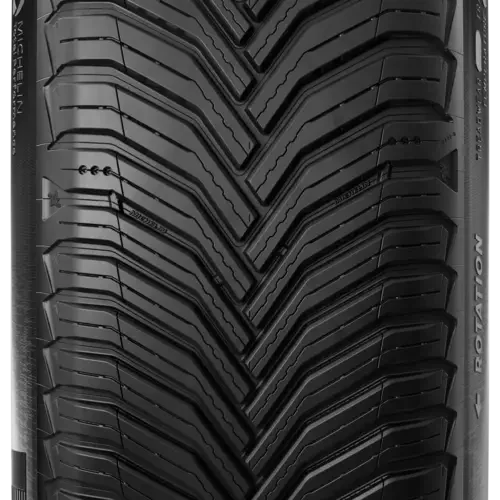
Modern performance all-season tires have steadily become more sophisticated at this trade-off. Many use 3D sipes, sipes with an interlocking geometry in cross-section, rather than simple straight cuts. This allows the sipes to open and provide traction in wet or cold conditions while mechanically locking the tread block together under lateral load. Looking at the tread pattern of a tire like the Michelin CrossClimate 2 and counting the sipes in each block, you are seeing several iterations of compound and geometry optimization.
Tread Wear Indicators
Every tire sold in the United States has tread wear indicators (TWI) molded into the main circumferential tread grooves. They are small raised ridges at the groove base, positioned at 2/32” (1.6mm) of tread depth. When the tread surface wears down to the indicator, the ridge becomes flush with the tread surface and the tire is at the legal minimum.
Indicator locations are marked on the tire’s shoulder, typically with a small arrow, triangle, or the letters TWI. They are positioned at six to eight points around the circumference so you can check wear at multiple spots across the tread. Some manufacturers make this especially clear. Continental’s DWS series indicate whether the tire is still good for Dry, Wet, or Snow indicated by D, W, and S letters cut into the tread that disappear as the tire wears.
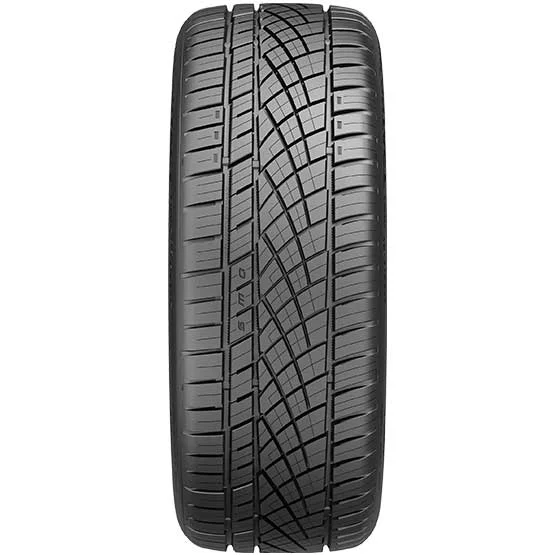
A tread depth gauge costs a few dollars and takes five seconds per tire. Eyeballing is not a tread check. More importantly, 2/32” is the legal minimum, not the performance minimum. Wet braking distance increases measurably below 4/32” as the tread’s ability to channel water out of the contact patch diminishes. If you drive in regular rain, 4/32” is a more practical replacement threshold than the legal floor.
Belts and Cap Ply
Underneath the tread, a tire’s structure includes body plies, typically one or two polyester cord layers, and a steel belt package. Most passenger tires have two steel belts under the tread. These belts stabilize the tread area and give the tire its flat contact patch under load.
Above the steel belts is the cap ply, also called the overlay or jointless breaker. The cap ply is wound circumferentially over the belt package and acts as a hoop, preventing the belt from expanding at high speed. As a tire rotates at speed, centrifugal force acts on the belt package, pulling it outward. Without a cap ply, this growth deforms the contact patch and creates instability. The cap ply holds the assembly together.
For lower speed ratings, standard nylon is a common material for cap plies. V, W, Y, and ZR speed-rated tires require higher-strength materials, including high-tenacity nylon, polyamide, or aramid, sold under the Kevlar brand by DuPont. Aramid is lighter than steel with dramatically higher tensile strength. It appears in cap plies and occasionally in sidewall reinforcement on performance and EV tires.
Sidewall Construction
A tire sidewall is not just rubber. Working from the inside out, there is an inner liner, a butyl rubber layer that holds air, body plies which are polyester cords carrying structural load, and the outer rubber compound that protects against curb contact and UV. In a standard load tire these elements are relatively straightforward. In an extra load (XL) tire, additional cord or belt material at the sidewall edges increases load capacity. The stiffer sidewall construction is why XL tires feel slightly firmer in ride quality than their standard load equivalents.
Run-flat sidewalls are a distinct variant. A self-supporting run-flat tire reinforces the sidewall with a hard rubber insert that maintains the tire’s shape under load even at zero air pressure. The insert is the source of the ride quality complaints about run-flat tires — it adds stiffness that is present even when the tire is properly inflated. See Run-Flat Tire Technology for the full breakdown of self-supporting, support ring, and self-sealing variants.
Foam-Lined Tires
Road noise inside a car comes from multiple sources, and they sound different enough that you can usually identify which one is bothering you. Tread pattern noise is the broadband hiss or roar you hear on coarse pavement. It is generated by tread blocks striking the road, air being expelled from the grooves as they enter the contact patch, and the texture interaction between rubber and road. It increases with speed, changes character on different road surfaces, and is the dominant complaint with aggressive all-terrain or performance tread designs at highway speeds. If you can hear the roar of a lifted truck coming at you, this is from tread pattern noise.
Sidewall flex noise is lower in pitch and more thuddy: a moan or groan that tracks with road texture rather than sitting at a constant frequency. It comes from the sidewall compressing and recovering over surface irregularities. Low-profile tires amplify it because there is less sidewall height to absorb the deformation. On grooved or rough pavement it can feel as much like vibration as sound.
Cavity resonance is a tonal hum created by air vibrating inside the tire’s air cavity. It has a characteristic frequency that typically falls in the 200–250 Hz range for a standard passenger tire, and it is audible as a persistent low drone that changes with speed rather than road surface.
Acoustic foam liners address cavity resonance by bonding polyurethane foam to the inner tread area. The foam dampens the resonant vibration and reduces interior noise at that frequency band. Because it targets a specific frequency from inside the tire, it cannot affect tread pattern or tire-road surface noise. Manufacturers have different names for their foam-lined tires: Michelin Acoustic, Pirelli PNCS (Pirelli Noise Cancelling System), Continental ContiSilent, and Goodyear SCT (SoundComfort Technology). All of these are foam bonded to the inside of the tread area.
Self-Sealing
Self-sealing technology is a sealant compound applied to the inner liner behind the tread area. If the tire is punctured by a small object (typically up to approximately 5mm in diameter), the sealant flows into and around the puncture point, sealing the hole without driver action. The tire may lose a small amount of pressure but remains functional. Continental markets this as ContiSeal, Pirelli as Seal Inside, Michelin as Selfseal, Goodyear as SealTech, and Bridgestone as B-SEALS. Self-sealing tires are heavier than standard tires, and the sealant compound is not compatible with conventional plug-and-patch repair at a shop, since it contaminates the inner liner.
Some tires include both foam and sealant as separate features. A tire marked “Acoustic” and “ContiSeal” has both a foam liner for resonance damping and a sealant layer for puncture resistance. Check the product specification if you care about one or both.
Marketing Terms Decoded
3D sipes — sipes with interlocking cross-section geometry. Allow siping to open for wet and cold traction while resisting tread block squirm under lateral cornering load.
Acoustic, ContiSilent, PNCS, SoundComfort — brand names for foam liners bonded to the inner tread area. Different names for the same feature: cavity resonance damping.
Aramid, Kevlar — high-strength fiber used in cap plies or sidewall reinforcement. Lighter than steel, higher tensile strength. Used where weight and strength matter — not inherently better in every application.
EV-rated — developed with electric vehicle use cases as targets. Not a standardized specification. Read the product description for what that means for the specific product.
OE designation (T0, N0, MO, Star) — see How to Read a Tire Sidewall for the full breakdown. These indicate certification by a specific vehicle manufacturer. The underlying compound is usually available without the OE designation at lower cost.
Self-sealing (B-SEALS, ContiSeal, Seal Inside, SealTech, Selfseal) — sealant compound on the inner liner that plugs small punctures automatically. Not compatible with conventional plug-and-patch repair.
Silica-enhanced, high-silica compound — partial or dominant silica filler replacing carbon black. Better wet grip and lower rolling resistance than carbon black formulations. Standard in modern performance and all-season tires.
Variable compound, dual compound — the center tread strip and the shoulder zones use different formulations. Centers optimize rolling resistance; shoulders optimize cornering grip. Common in grand touring tires where both efficiency and handling are priorities.
You did it. You got to the end. Amazing. Now you know why sipes on a winter tire are not a defect, what silica actually does compared to carbon black, and which four acoustic brand names all describe the same piece of foam. Have a burning question you want answered in a guide? Email us at hello@rimlist.com.