You did it. You saved up enough for that amazing new sports car. Then it happens. It is 25°F outside and your car slides through a stop sign on dry pavement. It turns out your car came from the factory with summer performance tires and you didn’t realize you needed a different set for winter temperatures. The world of tire tread patterns and performance categories is filled with marketing terms that sound similar but describe wildly different products. By the end of this article you will know exactly what tire category you need, how to read tread patterns, and why the tire you want might not be the tire you actually need.
Tread Pattern Types
Before we dive into tire categories, let’s understand the three basic tread pattern designs. The tread pattern affects how a tire performs in dry, wet, and winter conditions, how it wears, and even how you can rotate it.
Symmetric Tread Pattern
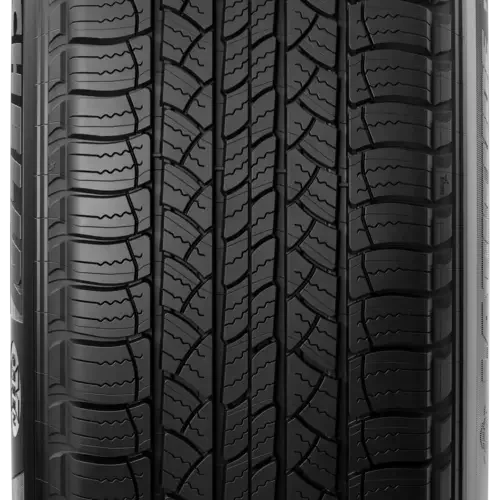
A symmetric tread pattern has the same design on both the inner and outer halves of the tire. If you drew a line down the center of the tread, both sides would mirror each other. Symmetric patterns are the simplest and most common design, found on most budget tires, all-season tires, and many touring tires.
The advantage of a symmetric pattern is that the tire can be mounted in any direction and rotated in any pattern. This makes tire rotation simple and maximizes tire life. Symmetric patterns typically provide good treadwear and a quiet, comfortable ride. The disadvantage is that they cannot be optimized for specific performance characteristics like cornering grip or water evacuation in the same way asymmetric or directional patterns can.
Asymmetric Tread Pattern
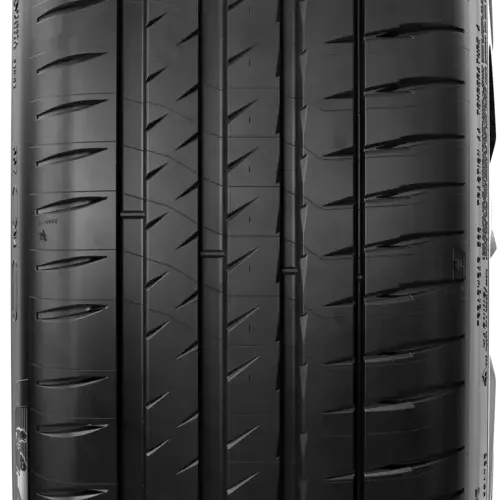
An asymmetric tread pattern features different designs on the inner and outer halves of the tire. The outer tread typically has larger, stiffer blocks for cornering grip while the inner tread has more grooves for water evacuation and wet traction. This allows the tire to be optimized for multiple performance characteristics simultaneously.
Asymmetric tires are marked with OUTSIDE or INSIDE on the sidewall, or sometimes just OUTSIDE on the outer sidewall. The tire must be mounted with the correct side facing out, but it can be mounted on either side of the vehicle and rotated front-to-back. Many modern performance tires, like the popular Michelin Pilot Sport 4S for example, use asymmetric patterns.
The advantage of asymmetric patterns is superior dry grip, better wet performance, and improved cornering stability compared to symmetric designs. The trade-off is typically slightly higher cost and you need to pay attention during installation to ensure the correct side faces outward.
Directional Tread Pattern
A directional tread pattern features a V-shaped design that channels water outward from the center of the tire. The pattern is optimized to rotate in one specific direction and the tire will have an arrow molded into the sidewall indicating the direction of rotation. The most obvious example of this is the Michelin CrossClimate, which features a distinctive V-shaped tread pattern.
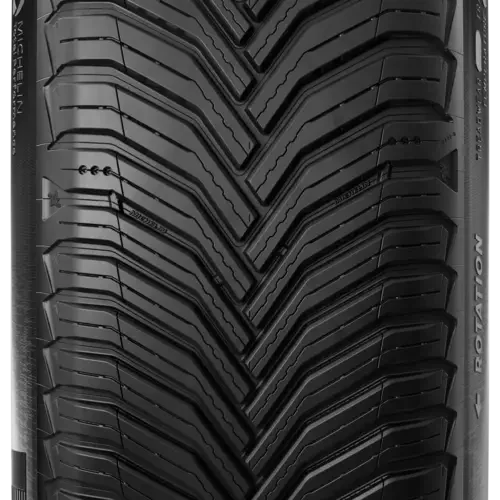
Directional tires must be mounted so the arrow points in the direction of forward travel. This means a directional tire mounted on the left side cannot be moved to the right side without dismounting and remounting it. This is indicated on the sidewall with an arrow and ROTATION indicator. You can only rotate directional tires front-to-back on the same side of the vehicle.
The advantage of directional patterns is exceptional water evacuation and hydroplaning resistance. The V-shaped grooves aggressively channel water away from the contact patch. The disadvantage is limited rotation patterns and the need to ensure correct installation direction. Many winter tires and high-performance wet weather tires use directional patterns.
Some manufacturers have created directional asymmetric patterns that combine both design philosophies but these require side-specific tires and cannot be rotated without dismounting and remounting.
All-Season Tires
All-season tires are the default choice for most passenger vehicles in North America. They are designed to provide acceptable performance in dry conditions, wet conditions, and light winter weather. The key word is “acceptable.” All-season tires are a jack of all trades and master of none.
All-season tires use a harder rubber compound that remains flexible across a wide temperature range. The tread patterns typically feature moderate sipes, small slits in the tread blocks, for light snow traction and circumferential grooves for water evacuation. All-season tires carry the M+S (Mud and Snow) marking but not the 3PMSF (Three Peak Mountain Snowflake) symbol, meaning they have not been certified for winter traction on packed snow.
All-season tires prioritize longevity, comfort, and low road noise over outright performance. They make sense for drivers in mild climates who experience temperatures that rarely drop below freezing. They are also the economical choice for drivers who do not push their vehicles hard and prioritize long tread life (typically 60,000 to 80,000 miles) and low cost.
The disadvantages are compromised performance in every category. All-season tires provide less dry grip than summer tires and significantly less winter traction than winter or all-weather tires. If you live somewhere with real winters where temperatures consistently drop below freezing or you see snow, all-season tires are not the right choice despite the name.
All-Weather Tires
Here is where the confusion begins. All-weather tires sound like all-season tires but have a fundamental distinction. All-weather tires carry the 3PMSF (Three Peak Mountain Snowflake) symbol, meaning they have been tested and certified for winter traction on medium packed snow.
All-weather tires use advanced rubber compounds that remain flexible in both warm and cold temperatures. The tread patterns feature aggressive siping, deep grooves, and biting edges designed for winter traction while still providing acceptable warm weather performance. Think of all-weather tires as a winter tire that doesn’t completely suck in the summer.
The advantage of all-weather tires is year-round capability with one set of tires. You do not need to swap to winter tires when temperatures drop. The disadvantage is compromised performance compared to dedicated summer or winter tires. All-weather tires cannot match the dry grip of summer tires or the ice traction of dedicated winter tires.
All-weather tires do not make sense for performance enthusiasts who drive aggressively or track their cars. The same rubber compound and tread design that provides winter grip reduces dry performance. Their compound compromises (soft enough for winter, firm enough for summer) mean they wear faster under aggressive driving than a dedicated summer or winter tire. If you live in an area with severe winter conditions or frequent ice, dedicated winter tires will outperform all-weather tires.
Summer Performance Tires
Summer performance tires are designed to provide maximum dry and wet grip in warm weather. They use softer rubber compounds optimized for temperatures above 40°F and feature aggressive tread patterns with large contact patches. The trade-offs are reduced tread life, no winter capability, and often higher cost.
Summer tires typically feature asymmetric tread patterns with large outer tread blocks for cornering grip and inner grooves for wet traction. The rubber compounds are formulated to remain sticky at high temperatures without overheating or chunking. This is why summer tires provide dramatically better dry grip, shorter braking distances, and higher cornering limits than all-season tires.
However, below 40°F the rubber compounds in summer tires begin to harden and lose grip even on dry pavement. In freezing temperatures, summer tires can become dangerously slippery. The tread patterns also lack the siping and grooves needed for snow and ice. Using summer performance tires in winter conditions is unsafe and can lead to loss of control even on dry roads.
Summer tires also include ultra-high performance (UHP) and max performance categories, which push close to track performance with minimal tread depth and extremely soft compounds. These tires are often found on performance sedans and sport-focused vehicles.
Sitting at the boundary between street and track is the Extreme Performance Summer category, commonly referred to as “200TW” tires for their UTQG treadwear ratings in the 100-200 range. Tires like the Yokohama Advan A052, Bridgestone Potenza RE-71RS, and Vitour Tempesta P1 P-01R are popular with track day enthusiasts who want dramatically more grip than standard summer tires without committing to a dedicated R-Compound setup. These tires can be driven on the street and many enthusiasts use them as a track day tire that doubles as a spirited street tire in warm months.
| Tire Category | Treadwear (UTQG) | Dry Grip | Wet Grip | Winter Use | Typical Lifespan |
|---|---|---|---|---|---|
| All-Season | 500-800 | Fair | Good | Light Only | 60,000-80,000 mi |
| Summer Performance | 300-500 | Excellent | Excellent | No | 30,000-50,000 mi |
| Max Performance Summer | 200-340 | Extreme | Excellent | No | 15,000-30,000 mi |
Winter and Snow Tires
Winter tires, also called snow tires, are purpose-built for cold weather, snow, and ice. They use rubber compounds specifically formulated to remain soft and grippy below 40°F. The tread patterns feature deep grooves, aggressive siping, and biting edges designed to dig into snow and channel slush. All winter tires carry the 3PMSF symbol.
The difference in winter performance between winter tires and all-season tires is staggering. Tests consistently show winter tires reduce braking distances on snow and ice by 30-50% compared to all-season tires. The improvement in traction, cornering grip, and control is equally dramatic. If you live somewhere with consistent winter weather, winter tires are not optional. They are a safety requirement.
Modern winter tires are separated into two categories: studless and studded.
Studless Winter Tires
Studless winter tires use advanced rubber compounds and microscopic pores in the tread to grip ice. The tread patterns feature thousands of tiny sipes that create biting edges. Popular studless winter tire models include the Bridgestone Blizzak WS90, Michelin X-Ice Snow, Continental VikingContact 7, and Nokian Hakkapeliitta R5.
Studless tires provide excellent snow and ice traction without the downsides of studs. They are quieter, do not damage roads, and provide better dry pavement performance than studded tires. They are legal everywhere and suitable for the vast majority of winter driving conditions.
The disadvantage of studless tires is slightly reduced traction on pure ice compared to studded tires, particularly on steep grades or glare ice. For most drivers in most winter conditions, this difference is negligible and modern studless winter tires provide exceptional ice grip.
Studded Winter Tires
Studded winter tires feature metal studs embedded in the tread that physically dig into ice. The studs provide maximum traction on ice and hard-packed snow. Studded tire models include the Nokian Hakkapeliitta 10, Bridgestone Blizzak Spike-01, and General Altimax Arctic.
The advantage of studded tires is ultimate ice traction. The metal studs bite into ice and provide grip that no rubber-only tire can match. Studded tires are the right choice for extreme winter climates with consistent ice, steep grades, or rural areas where roads are not plowed or salted regularly.
The disadvantages are numerous. Studded tires are loud on dry pavement, damage roads, reduce dry and wet traction compared to studless tires, and are illegal or restricted in many regions. Many U.S. states ban studded tires or restrict them to winter months only due to road damage. If you do not face consistent ice conditions, studless winter tires are the better choice.
Track and Competition Tires
Track tires are designed for maximum dry grip in competitive motorsports. They sacrifice tread life, wet performance, comfort, and cost for ultimate dry traction. Track tires are separated into two categories: R-compound DOT tires and DOT Competition tires.
R-Compound DOT Tires
R-compound tires use racing-derived rubber compounds that are softer and stickier than street-focused summer performance tires. They are DOT-approved and street legal but optimized for track use. R-compound tires feature minimal tread depth (often 4-5/32” new), large contact patches, and tread patterns designed primarily for heat management rather than water evacuation.
Popular R-compound DOT tires include the Michelin Pilot Sport Cup 2, Nitto NT01, and Nankang AR-1. These tires are the weapon of choice for time attack, autocross, and track day enthusiasts who want maximum grip while retaining the ability for a relatively short drive to and from the track.
The advantages are obvious: dramatically more dry grip than any street tire, shorter braking distances, higher cornering speeds, and better track times. The disadvantages are equally dramatic. R-compound tires wear extremely quickly, provide minimal wet traction, are dangerous in cold weather, cost significantly more than street tires, and require proper heat cycling and storage.
R-compound tires are not daily driver tires. They are not “sporty all-seasons.” They are purpose-built track tires that happen to be street legal.
DOT Competition Tires
DOT competition tires sit between R-compound tires and full race slicks. They feature extremely soft compounds, nearly slick tread patterns with minimal grooves, and construction designed for racing. Examples include the Hoosier A7 and R7, Toyo Proxes RR, and Pirelli P Zero Trofeo Track.
These tires are used in club racing, competitive time attack, and other motorsports where DOT approval is required but ultimate grip is the goal. They offer more grip than standard R-compound tires but still less than full slicks. Tread life is measured in heat cycles (typically 15-30 cycles) rather than miles. DOT competition tires require tire warmers, proper heat cycling, careful pressure management, and camber optimization to work properly. They are not suitable for street use beyond driving through the paddock.
Above DOT competition tires sit full racing slicks. They have no tread pattern, are not DOT-approved, and are technically illegal on public roads. Slicks are used in professional racing series and are not relevant to anything street or even typical club racing. You can typically recognize a full slick as their sizing conventions are completely different than street tires and they will typically have very little information on their sidewalls.
Tire Technology: Grooves, Blocks, and Siping
Now that we understand tire categories, let’s examine the specific design elements that make them work. Three primary technologies define tread patterns: circumferential grooves, tread blocks, and siping.
Circumferential Grooves
Circumferential grooves are the wide channels that run around the tire parallel to the direction of travel. These grooves serve several purposes: evacuating water to prevent hydroplaning, allowing the tire to flex and dissipate heat, and creating distinct tread blocks.
The depth, width, and number of circumferential grooves directly affect wet performance and tread life. Deeper, wider grooves channel more water but reduce the contact patch and dry grip. Summer performance tires have fewer, shallower grooves to maximize the contact patch. All-season and all-weather tires have deeper, more numerous grooves for year-round wet traction.
The void ratio is the percentage of the tread that is grooves versus rubber. Summer performance tires might have a 25-30% void ratio while all-season tires can exceed 35-40%. Racing slicks have a 0% void ratio.
Tread Blocks
Tread blocks are the raised rubber sections separated by grooves. The size, shape, and stiffness of tread blocks determine how the tire grips the road, wears, and handles forces during acceleration, braking, and cornering.
Larger, stiffer tread blocks provide better dry grip and more precise steering response but can be noisier and wear unevenly. Smaller, more flexible blocks provide a quieter ride and more even wear but less outright grip. The arrangement of blocks also affects tread wear patterns.
Shoulder blocks are the outer tread blocks that handle cornering forces. Performance tires use large, continuous shoulder blocks for maximum lateral grip. Touring tires use smaller shoulder blocks and variable pitch patterns to reduce road noise.
Siping
Siping refers to the thin slits cut into tread blocks. These microscopic cuts create additional biting edges that improve traction on wet roads, snow, and ice. Siping increases the number of edges that can grip the road without significantly reducing the contact patch.
All-season tires feature moderate siping for light winter traction and wet grip. All-weather and winter tires feature aggressive 3D siping with interlocking wave patterns that maintain block stiffness while creating thousands of biting edges. Summer performance tires have minimal siping to maximize tread block stiffness and dry grip.
The downside of siping is reduced tread block stiffness which can decrease dry performance and increase irregular wear. This is why summer tires minimize siping while winter tires maximize it.
Phew. You now know the difference between all-season and all-weather, why your summer tires are terrifying in winter, and what those little slits in your tread blocks actually do. If you are ready to translate that into a purchase decision, the Tire Buying Guide by Use Case starts from your situation and walks through specific recommendations by use case, including budget guidance and where to buy. You can also browse our vehicle-specific tire guides, such as the Tesla Model 3 and Rivian R1S, to see how these categories apply to specific platforms.